What Is Neuromorphic Computing? A Simple Explanation
Neuromorphic computing harnesses brain-inspired architecture for energy-efficient AI. Learn how spiking neural networks and edge computing.
Neuromorphic computing represents a paradigm shift in how we approach artificial intelligence and computational power. Unlike traditional computers that rely on the von Neumann architecture—which separates processing and memory into distinct units—neuromorphic computing mimics the structure and function of the human brain itself. This revolutionary approach brings together biological inspiration, neuroscience principles, and cutting-edge engineering to create systems that are not only more efficient but also far more adaptable than conventional computing architectures.
The human brain operates on approximately twenty watts of power—equivalent to just two standard LED bulbs—yet performs incredibly complex cognitive tasks that require massive amounts of computational resources in traditional systems. This remarkable efficiency is the driving force behind neuromorphic computing. By borrowing from biology and implementing brain-inspired computing principles, researchers have developed hardware and algorithms that dramatically reduce energy consumption while improving processing speed and adaptability. The technology has transitioned from theoretical research conducted in academic institutions to practical, real-world applications in autonomous systems, edge computing, and artificial intelligence accelerators.
Neuromorphic computing addresses one of the most pressing challenges facing modern technology: the astronomical energy demands of conventional artificial intelligence systems. As data centers and AI applications continue to expand globally, the power consumption and environmental impact become increasingly concerning. Brain-inspired architecture offers a compelling solution by implementing event-driven processing, where computation occurs only when necessary, rather than continuously like traditional processors.
This makes neuromorphic computing particularly valuable for edge computing applications, where devices operate under strict power and size constraints. Whether in autonomous vehicles, medical diagnostic systems, robotics, or Internet of Things (IoT) applications, neuromorphic systems are proving their worth by delivering sophisticated intelligence with minimal energy requirements.
What Exactly Is Neuromorphic Computing?
Neuromorphic computing, at its core, is a computer engineering discipline dedicated to designing hardware and software systems that replicate the structure, processes, and operational capabilities of biological neural networks found in animal brains. The term “neuromorphic” combines two Greek words: “neuro” (pertaining to nerves or the nervous system) and “morph” (form or structure), literally meaning “nerve-like” or “brain-shaped.”
The fundamental premise of neuromorphic computing is deceptively simple yet profoundly powerful: instead of forcing brain-like computational problems into architectures designed for sequential, deterministic operations, why not design computers that naturally mirror the brain’s information-processing mechanisms? This approach differs fundamentally from traditional deep learning, which uses artificial neural networks (ANNs) running on conventional hardware. Neuromorphic systems physically embody neural principles in their hardware architecture rather than merely simulating them through software.
In traditional computers, data travels repeatedly between the processor and memory, creating what computer scientists call the “von Neumann bottleneck.” This constant movement of data consumes enormous amounts of power and creates latency delays. Neuromorphic computing eliminates this problem by collocating memory and processing, much like biological brains do. Individual neuromorphic processors contain embedded memory, allowing each processing unit to maintain its own state and perform local computations, drastically improving efficiency.
The most common implementation of neuromorphic computing involves spiking neural networks (SNNs), which encode and process information through discrete events—specifically, neural “spikes” or action potentials—rather than continuous numerical values. This event-driven processing approach means that neurons only consume power when they fire, making systems inherently more energy-efficient than traditional approaches.
Spiking Neural Networks (SNNs)


How SNNs Differ from Traditional Neural Networks
- Spiking neural networks represent a fundamental departure from the artificial neural networks that power today’s most popular deep learning systems. To understand this difference, consider how information is encoded in each system. Traditional artificial neural networks process information using continuous activation functions—essentially, neurons output smooth, continuously varying values between zero and one (or other ranges). These outputs represent probabilities, confidence levels, or similar metrics that feed into subsequent network layers.
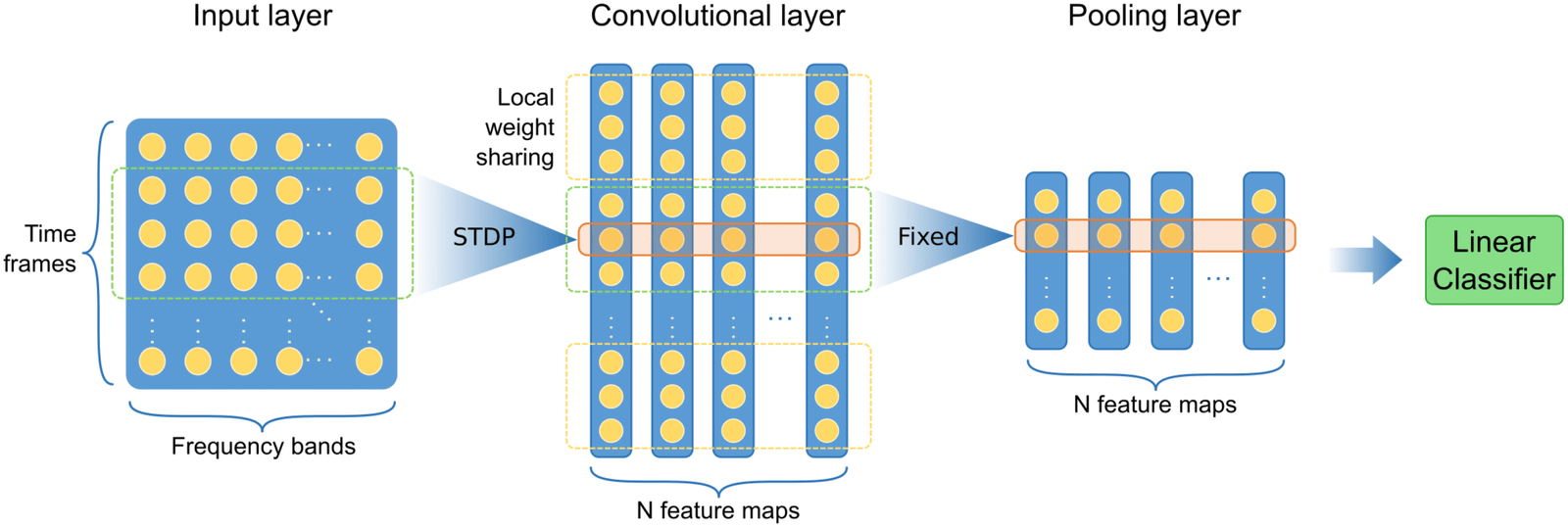
- Spiking neural networks, by contrast, transmit information through discrete, binary pulses—spikes or action potentials—that occur at specific moments in time. Each spiking neuron has a membrane potential that accumulates over time; when this potential reaches a threshold, the neuron “fires,” sending a spike to connected neurons, then resets to a resting state. This threshold-crossing behavior, inspired directly by biological neurons, creates a fundamentally different computational paradigm.
This distinction creates profound implications for brain-inspired computing. Because spiking neural networks rely on temporal dynamics—the precise timing of spikes carries information—they can encode more information with fewer spikes than traditional networks require continuous activations. Additionally, because neurons only transmit spikes when necessary, most neurons remain silent most of the time, enabling the sparse, efficient communication that makes neuromorphic computing so energy-efficient.
Key Characteristics of SNNs
Spiking neural networks possess several defining characteristics that make them ideal for neuromorphic systems. First, they exhibit remarkable temporal processing capabilities. Since spike timing is crucial, SNNs naturally handle time-series data and sequential information without requiring the recurrent architectures that traditional networks need. This makes them particularly effective for tasks involving sensor streams, real-time data, and dynamic environments.
Second, spiking neural networks enable true event-driven processing. Unlike traditional networks that continuously process data in synchronized batches, SNNs only activate when input events occur. A silent sensory input consumes no computational resources—the system remains dormant until stimulated. This represents a fundamental shift from synchronous to asynchronous computation, mirroring how biological brains operate.
Third, spiking neural networks naturally implement synaptic plasticity, the brain’s ability to strengthen or weaken connections between neurons based on experience. This is accomplished through mechanisms like spike-timing-dependent plasticity (STDP), where the relative timing of presynaptic and postsynaptic spikes determines whether synaptic connections strengthen or weaken. This learning mechanism is far more biologically realistic than backpropagation and can be implemented directly in analog hardware.
Core Hardware: Neuromorphic Processors
State-of-the-Art Neuromorphic Chips
The hardware foundation of neuromorphic computing consists of specialized neuromorphic processors designed specifically to implement spiking neural networks efficiently. Several pioneering platforms exemplify the current state of the technology.
- Intel’s Loihi represents one of the most advanced neuromorphic processors available today. This digital neuromorphic chip contains 128 neuromorphic cores, with each core housing 1,024 neurons and programmable synapses connecting them. Loihi incorporates on-chip learning capabilities, allowing the system to adapt and learn in real-time during deployment, not just during training phases. The architecture supports event-driven processing, where only active neurons consume power, and features a flexible programming model that researchers have adapted for diverse applications.
- IBM’s TrueNorth was among the first commercial neuromorphic processors to gain significant attention. This neuromorphic chip contains approximately 1 million programmable neurons and 256 million configurable synapses. With ultra-low power consumption—just 70 milliwatts during typical operation—TrueNorth demonstrates the dramatic power advantages that neuromorphic computing achieves. Each neuron operates with programmable parameters, including threshold values, neuron model, and synaptic connections, offering researchers tremendous flexibility for implementing diverse neural algorithms.
- BrainScaleS, developed through the European Union’s Human Brain Project, takes a different approach by combining analog and digital circuits. Its accelerated neuron model allows BrainScaleS to simulate neuron dynamics faster than biological time, making it ideal for studying brain function and testing algorithms before deployment on real neuromorphic hardware.
In-Memory Computing and Circuit Design
Neuromorphic hardware increasingly incorporates in-memory computing (also called computation-in-memory or CIM), where data processing happens directly within memory units rather than shuttling data back and forth between separated processor and storage. This architectural innovation addresses one of the key limitations of traditional computers—the von Neumann bottleneck—by physically co-locating computation and storage, just like biological brains.
Memristive devices, also called resistive RAM (ReRAM), show particular promise for in-memory computing in neuromorphic systems. These nanoelectric components exhibit analog behavior and can store information through resistance states, functioning simultaneously as memory elements and computational devices. When used to implement neuromorphic circuits, memristors can model synaptic connections with remarkable efficiency, storing synaptic weights while simultaneously performing weighted summation operations.
Key Advantages of Neuromorphic Computing
Energy Efficiency
The most compelling advantage of neuromorphic computing is its extraordinary energy efficiency. Traditional artificial intelligence systems consume kilowatts of power for complex cognitive tasks, while neuromorphic processors accomplish equivalent or superior tasks using milliwatts—a difference of thousands of times. This dramatic reduction stems from the event-driven processing nature of spiking neural networks. Most neurons remain inactive most of the time, consuming negligible power. Only when sensory input stimulates activity do relevant neurons activate and consume energy.
For edge computing applications where devices operate on battery power—such as autonomous drones, implanted medical sensors, or remote monitoring systems—this energy advantage is transformative. A neuromorphic system can run for weeks or months on power budgets that would exhaust traditional AI systems in hours.
Real-Time Processing and Low Latency
Neuromorphic computing excels at real-time processing tasks requiring minimal latency. Because spiking neural networks process information asynchronously in response to events, they avoid the batch-processing delays inherent in traditional deep learning pipelines. Input information propagates through the network and produces output decisions with latency measured in milliseconds or even microseconds, rather than requiring batches of samples to accumulate before processing begins.
This latency advantage makes neuromorphic systems ideal for safety-critical applications like autonomous vehicles, where decision-making must occur in real-time. A neuromorphic processor can process sensory information and generate control signals with minimal delay, enabling rapid responses to unexpected obstacles or changing road conditions.
Adaptive Learning and Plasticity
Unlike traditional neural networks that require complete retraining when deployed to new environments or when receiving new types of data, neuromorphic systems naturally implement online learning through synaptic plasticity mechanisms. A neuromorphic processor deployed in the field can continuously adapt to its specific environment, improving performance over time without requiring feedback to a training system.
This lifelong learning capability makes neuromorphic computing particularly suited for long-term autonomy in dynamic environments. A robot operating for years in an industrial setting can continuously improve its performance by learning from its experience, rather than remaining static with fixed parameters trained months or years prior.
Inherent Robustness
Recent research demonstrates that spiking neural networks exhibit superior robustness compared to traditional artificial neural networks, particularly against adversarial attacks—carefully crafted inputs designed to fool neural networks. This robustness emerges naturally from the temporal processing and sparse coding properties of SNNs. The temporal dimension provides an additional layer of security that attackers must manipulate, while sparse event-driven processing makes the system less sensitive to subtle perturbations in sensory input.
Applications of Neuromorphic Computing
Autonomous Systems and Robotics
Neuromorphic processors are transforming autonomous systems by enabling real-time sensory processing combined with adaptive decision-making. Autonomous vehicles benefit from the low latency and energy efficiency of neuromorphic computing, while robots gain the ability to learn and adapt within their operational environments. Search and rescue robots, industrial inspection drones, and autonomous underwater vehicles all leverage neuromorphic systems to balance processing power against battery constraints.
Medical and Healthcare Applications
Neuromorphic computing enables sophisticated medical applications with minimal power consumption, critical for implantable devices and wearable health monitors. Neuromorphic processors can detect seizures from neural recordings, classify cardiac arrhythmias from physiological signals, and diagnose disease states in real-time, all while consuming power levels compatible with battery operation or wireless power transfer.
Edge AI and IoT Devices
Internet of Things (IoT) devices scattered across smart cities, industrial facilities, and environmental monitoring networks require substantial artificial intelligence capabilities despite severe power constraints. Neuromorphic processors enable these devices to perform sophisticated machine learning tasks—image recognition, anomaly detection, pattern classification—directly on the device without uploading raw sensory data to cloud systems. This edge computing approach improves privacy, reduces network bandwidth requirements, and decreases latency.
Scientific Research and Brain Simulation
The Human Brain Project and similar large-scale neuroscience initiatives use neuromorphic hardware platforms to simulate brain function at scale, helping scientists understand neural mechanisms underlying cognition, learning, and neurological diseases. These simulations accelerate scientific discovery while validating algorithmic approaches before deployment in practical applications.
Challenges and Future Directions
Programming and Software Ecosystems
One significant challenge facing neuromorphic computing is the lack of standardized programming tools and frameworks. Traditional deep learning offers mature ecosystems with TensorFlow, PyTorch, and similar platforms that facilitate model development. Neuromorphic systems currently lack comparable standardization, forcing developers to work with platform-specific programming models. Addressing this challenge through open-source frameworks and standardized abstractions remains an active research priority.
Scalability and Manufacturing
Scaling neuromorphic processors to handle increasingly complex neural networks while maintaining manufacturability at reasonable cost presents significant engineering challenges. Current neuromorphic chips contain millions of neurons, but future applications may require billions. Developing manufacturing processes and architectural strategies to achieve this scale while managing power consumption and heat dissipation represents a major research frontier.
Integration with Existing Systems
Most organizations have invested heavily in conventional computing infrastructure. Integrating neuromorphic processors into existing systems requires developing hybrid architectures that combine traditional processors with neuromorphic accelerators, along with software approaches for partitioning computation between the two systems. This integration challenge slows adoption despite the compelling advantages of neuromorphic computing.
More Read: Neuromorphic Computing: The Next Frontier in AI Technology
Conclusion
Neuromorphic computing represents a transformative approach to artificial intelligence and computation by abandoning the century-old von Neumann architecture in favor of brain-inspired computing principles. Through specialized neuromorphic processors implementing spiking neural networks with event-driven processing, this paradigm achieves extraordinary energy efficiency, real-time performance, and adaptive learning capabilities that conventional systems struggle to match.
As neuromorphic hardware matures, software ecosystems develop, and manufacturing scales up, this technology will increasingly power autonomous systems, edge devices, medical instruments, and scientific applications requiring intelligence and adaptability. The convergence of biological inspiration, materials science advances, and algorithmic innovations suggests that neuromorphic systems will play a central role in future artificial intelligence, delivering sophisticated machine intelligence within the power budgets required by an energy-conscious world.