Humanoid Robots in 2025: What’s Actually Possible
Discover what's really possible with humanoid robots in 2025. Explore current capabilities, real-world deployments, market trends, and limitations.
The humanoid robot industry in 2025 stands at a critical inflection point where reality meets hype. While viral videos showcase robots performing impressive acrobatic feats and handling complex tasks with apparent ease, the actual state of humanoid robot technology tells a more nuanced story. Industry observers estimate the global humanoid robot market was valued at $1.9 billion in 2025 and is projected to reach $11 billion by 2030, yet actual deployments remain limited to carefully controlled pilot programs in structured industrial environments. The excitement surrounding companies like Tesla, Boston Dynamics, Figure AI, and Unitree Robotics has captivated investors, with venture capital funding exceeding $2.5 billion in 2024 alone.
However, roboticists and industry analysts emphasize that we are still in the infancy of this technology. This article cuts through the noise to examine what humanoid robots can genuinely accomplish today, the significant obstacles they face, and the realistic timeline for broader adoption. Rather than celebrating concept videos, we’ll explore active pilots in manufacturing, logistics, and healthcare—where these machines are actually working alongside humans. Understanding the difference between demonstration capabilities and practical deployment is essential for anyone evaluating humanoid robot applications or considering investment in this rapidly evolving sector.
The Humanoid Robot Market in 2025: Market Size and Investment Trends
The humanoid robot market size has experienced explosive growth in venture funding, yet commercial adoption remains surprisingly limited. According to Bain & Company’s 2025 Technology Report, humanoid robots attracted approximately $2.5 billion in venture capital investment during 2024. Major investors, including NVIDIA, Google, and Amazon, have made significant commitments to humanoid robot development, signaling confidence in the sector’s long-term potential. Morgan Stanley Research predicts the humanoid robot market could reach an extraordinary $5 trillion by 2050, including supply chains, maintenance, and support services. However, this projection presupposes technological breakthroughs that remain years away.
Current market valuations reflect investor optimism rather than current revenue generation. Most companies offering humanoid robot solutions have deployed fewer than 100 units globally. The humanoid robot industry is segmented by application type, with personal assistance and caregiving representing the largest projected segment, followed by manufacturing and logistics. Asia-Pacific, particularly China, has emerged as the dominant region for humanoid robot adoption, driven by government initiatives and domestic supply chain advantages. The diversity of approaches—from bipedal designs emphasizing agility to wheeled systems prioritizing stability—demonstrates that the industry has not yet converged on standardized solutions.
Current Real-World Humanoid Robot Deployments and Use Cases
Despite widespread media coverage, humanoid robot deployments remain remarkably sparse in 2025. The most documented cases involve industrial pilots with leading manufacturers and logistics companies. Understanding these actual deployments is crucial for assessing what humanoid robots can realistically accomplish.
Manufacturing and Automotive Applications
The automotive sector leads humanoid robot adoption globally. Tesla’s Optimus Gen 2 is designed to assist with both industrial and domestic tasks, integrating cutting-edge AI while handling repetitive tasks, assisting in manufacturing, and performing home automation functions. Apptronik’s Apollo robot has entered pilot programs at Mercedes-Benz facilities, where it performs material handling and component inspection tasks. Figure 03 is capable of doing some domestic tasks like folding clothes and loading a dishwasher, but not without help, with humans needing to start the wash and help if it drops something.
However, these deployments are fundamentally different from autonomous operation. Most humanoid robot pilots require human supervision, remote operation, or extensive pre-programming for each task variant. As of late 2025, humanoid robots in automotive settings primarily perform basic tasks, including badge labeling, material handling, and visual inspection—not the complex assembly work that would justify large-scale replacement of human workers.
Logistics and Warehouse Operations
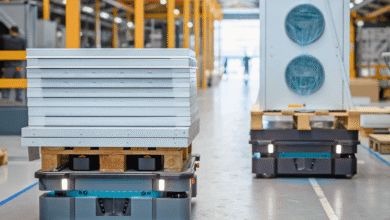
The logistics industry represents another significant focus for humanoid robot developers. Digit is designed for warehouse material handling and capable of operating in human-centric environments, lifting and carrying standard warehouse totes, navigating ramps and uneven flooring, and transferring items between storage racks and conveyors. Agility Robotics has deployed Digit in pilot programs with major logistics companies, with an estimated 250-300 units in active testing as of 2025.
UBTECH’s Walker S2 represents the most mature production deployment to date. UBTECH calls it the world’s first humanoid robot capable of autonomous battery swapping, designed for true round-the-clock industrial use, with factory use cases including smart inspections, logistics support, material handling and human–robot collaboration on automotive and electronics production lines, having shipped hundreds of Walker S2 units to partners like BYD, Nio, Zeekr, Geely, FAW-Volkswagen, and Foxconn.


Despite these accomplishments, warehouse deployments remain in early-stage testing. As of early 2025, IDTechEx has observed only a limited number of pilot projects, with fewer than 100 humanoids deployed in warehouses, and given that warehouse testing typically takes about 18 to 30 months, large-scale adoption is unlikely before the end of 2025.
Technical Capabilities Where Humanoid Robots Excel
Humanoid robot capabilities have advanced significantly in specific domains, particularly in perception, mobility, and AI-driven decision-making. Understanding these strengths provides perspective on where the technology genuinely adds value.
Perception and Vision Systems
Modern humanoid robots feature sophisticated sensor arrays including 3D cameras, LiDAR, radar, and tactile sensors. The 4NE-1 humanoid features state-of-the-art 3D vision, tactile feedback, and multi-modal interaction systems that enable it to intuitively perceive and respond to its surroundings. These humanoid robot vision systems enable robots to navigate complex environments, detect objects, and understand spatial relationships with increasing accuracy. AI integration, particularly through large language models, allows robots to interpret visual data contextually and respond to novel situations with greater flexibility than traditional industrial robots.
Bipedal Locomotion and Agility
Several humanoid robot models demonstrate impressive dynamic movement capabilities. Boston Dynamics’ Electric Atlas is built to execute complex motions, from running and jumping to performing precise maneuvers like backflips, and is ideal for tasks in search and rescue, industrial inspections, and research. Unitree Robotics’ H1 and its successor variants are high-performance humanoids capable of human-like running, jumping, balancing, and navigating complex terrain, with public videos showing genuine dynamic locomotion, including sprinting, jumping, and balancing after heavy pushes.
However, impressive locomotion in controlled demonstration settings does not translate automatically to reliable industrial performance. These robots are not very good about recovery—they are not like little kids who just back up and are light enough that they do not hurt anyone, but these are heavy machines, and if they fall over and fall onto a person, a person could be seriously injured.
Critical Limitations and the “Autonomy Gap”
Despite remarkable achievements in specific domains, humanoid robots face fundamental limitations that prevent widespread deployment. Understanding these constraints is essential for realistic expectations about near-term adoption.
The Autonomy Gap and Dependence on Human Oversight
Most humanoid robots today remain in pilot phases, heavily dependent on human input for navigation, dexterity, or task switching, with an “autonomy gap” being real as current demos often mask technical constraints through staged environments or remote supervision. This distinction between demonstration videos and actual autonomous operation represents perhaps the most significant barrier to adoption. Many viral videos showcase robots performing tasks flawlessly, yet these demonstrations often rely on remote human operators, pre-programmed pathways, or carefully staged environments.
Battery Life and Energy Constraints
Battery limitations represent a critical practical constraint for humanoid robot deployment. Most commercial humanoid robots operate for 4-8 hours on a single charge, requiring extended downtime for recharging. This drastically reduces utilization rates compared to traditional industrial robots, which operate continuously. While UBTECH’s Walker S2 addresses this through autonomous battery swapping, the need for charging stations adds infrastructure complexity and limits deployment flexibility. For logistics and manufacturing applications where continuous operation is valued, this limitation significantly impacts return on investment calculations.
Dexterity and Task Complexity
While humanoid robots possess multi-fingered hands, actual dexterity in complex manipulation tasks remains limited. Tasks requiring fine motor control, tool manipulation, or adaptation to unexpected object variations challenge current systems. Teaching robots to grasp and manipulate objects is still a major challenge, and one of the reasons we shouldn’t expect humanoid robots to become a fixture of our homes or workplaces within the next few years.
The Data Gap Challenge
Robotics researchers emphasize what UC Berkeley’s Ken Goldberg calls the “100,000-year data gap.” Goldberg describes how what he calls the “100,000-year data gap” will prevent robots from gaining real-world skills as quickly as AI chatbots are gaining language fluency. While large language models trained on internet-scale text data achieved fluency rapidly, physical robot skills require embodied learning in real-world scenarios. Collecting the volume of diverse, real-world training data necessary for general-purpose autonomy will require years of deployed robots gathering experience.
Leading Humanoid Robot Models and Their Specifications
The humanoid robot landscape encompasses diverse approaches, each with distinct capabilities and target applications. Understanding the leading platforms clarifies where the technology currently stands.
Tesla Optimus Gen 2
Tesla’s Optimus Gen 2 represents one of the most visible humanoid robot projects. Estimated to cost between $120,000 and $150,000 per unit, it features improved joint articulation compared to its predecessor. Tesla plans to produce 5,000 units in 2025 and at least 50,000 in 2026, though these targets assume resolution of manufacturing challenges that currently constrain production. The robot integrates Tesla’s AI capabilities with its robotics engineering, positioning it as a general-purpose platform. Current deployments focus on Tesla’s own manufacturing facilities, where it performs repetitive tasks in controlled environments.
Agility Robotics Digit
Agility Robotics’ Digit is estimated at around $250,000 in active pilot programs with major logistics companies, designed for warehouse material handling and capable of operating in human-centric environments. Agility has announced plans to manufacture over 10,000 units annually by 2026, though current production remains substantially lower. Digit’s bipedal design enables navigation of facilities designed for human workers, providing advantages over wheeled alternatives in environments with stairs, ramps, and uneven flooring.
Unitree Robotics Models
Unitree H1 is publicly listed at $90,000, making it one of the most affordable full-size bipedal robots available for commercial and research use, known for its high walking speed and modular upgrades. Unitree’s lower price point has attracted research institutions and educational organizations, creating a potential developer ecosystem. The G1 model emphasizes agility and cost-effectiveness, targeting service industries and research environments where budget constraints are significant.
Figure AI’s Figure 03
Figure 03 was capable of doing some domestic tasks like folding clothes and loading a dishwasher, but not without help, with the company having embarked on a mass data collection drive to train the robots’ Helix neural network to better complete more types of tasks. Figure AI has partnered with Samsung and other organizations to deploy robots in manufacturing and logistics settings. The company plans to place robots in select homes by 2026, though this timeline assumes rapid advancement in autonomous capability that many researchers consider optimistic.
Pricing, Production Capacity, and Cost Reduction Timelines
The humanoid robot’s cost structure currently presents a significant barrier to mass adoption. Understanding pricing trends provides insight into realistic deployment timelines. In 2025, humanoid robots cost between $30,000 and over $1 million, with price depending on capabilities, target industry, and production scale, while entry-level humanoids are designed for lighter service or research tasks, and high-end units are built for heavy-duty industrial work. Leading industrial models command premium prices due to expensive components and limited production volumes. Hardware components, particularly actuators, servo motors, dexterous hands, and sensors, account for 70-80% of the total system cost.
Production scale is essential for cost reduction, yet current manufacturing constraints limit volume growth. DIGITIMES Research estimates that humanoid robot component costs will decline approximately 15-20% annually as production increases, but achieving breakeven economics requires significantly lower unit costs than currently possible. IDTechEx forecasts that component costs, particularly for dexterous hands and high-precision actuators, will remain bottlenecks limiting production scale through 2027.
Geographic Adoption Patterns and Regional Strategies

Humanoid robot adoption patterns diverge significantly across regions, reflecting different economic priorities, labor market conditions, and government strategies.
China’s Government-Backed Strategy
China has positioned humanoid robots as a national technology priority. China put humanoids in the center of its national strategy, with the government wanting to showcase its competencies and global competitiveness in this field of technology, with a strong emphasis on using humanoids in the service sectors, such as customer service, and establishing a supply chain for key components that is scalable. Chinese manufacturers, including UBTECH and Unitree Robotics, enjoy advantages including lower labor costs, domestic supply chain integration, and government subsidies. Asia-Pacific leads in global demand for humanoid robots, driven by China’s aggressive commercialization strategy backed by government funding and integrated domestic supply chains that enable competitive mass production.
United States and Western Approach
In the United States, tech companies like NVIDIA, Amazon, and Tesla are heavily developing advanced AI and robotics technologies, with a strong interest in using humanoids in logistics and manufacturing, where these machines are seen as tools for enhancing productivity and efficiency rather than as social companions. The U.S. approach emphasizes general-purpose capability and advanced AI integration, with companies competing on intelligence rather than cost. However, manufacturing capacity constraints limit domestic production, with most companies relying on overseas manufacturing partnerships.
Japan’s Social Robot Focus
Japan has been a pioneer in humanoid robot development, with robots regarded as companions rather than mere tools, with humanoid robots such as Pepper and Palro designed primarily as social robots and used in educational settings, commercial stores, and elderly care facilities, reflecting the needs of Japan’s ageing society and focus on creating robots that can live harmoniously with humans.
Market Projections and Realistic Adoption Timelines
Forecasts for humanoid robot adoption vary dramatically depending on underlying assumptions about technological progress and market readiness. Establishing realistic timelines requires distinguishing optimistic projections from evidence-based analysis.
Morgan Stanley Research estimates the humanoids market will reach $5 trillion by 2050, with adoption being relatively slow until the mid-2030s, accelerating in the late 2030s and 2040s, with over 1 billion humanoids by 2050, and about 90% used for repetitive, simple, and structured work. This projection emphasizes the extended timeline for widespread adoption, despite near-term excitement.
More conservative analyses suggest slower near-term adoption. IDTechEx analysts anticipate that by 2026-2027, humanoid robots will start operating for specific use cases, gradually expanding to more complex tasks between 2028 and 2033, meaning that general-purpose humanoid robots in other non-industrial areas, such as healthcare, are even further away. These timelines reflect recognition that fundamental technological barriers—particularly in battery life, cost reduction, and autonomous capability—require years to overcome.
According to Yole Group’s new report, the global humanoid robot market will reach US$6 billion in 2030 and soar to US$51 billion in 2035, with ~55% CAGR, with shipments rising to ~136 thousand in 2030, and more than 2 million by 2035. This projection assumes accelerating deployment in the early 2030s as costs decline and capabilities improve.
The Reality Check: Challenges to Mass Adoption
The gap between investor expectations and technical reality remains substantial. Several fundamental challenges must be addressed before humanoid robots achieve widespread commercial adoption.
Safety and Regulatory Uncertainty
With growing human-robot interaction, the development of humanoid robots will need to focus not only on hardware and software factors but also on safety regulations as a key consideration. Current regulatory frameworks remain underdeveloped for humanoid robot deployment in shared human spaces. Unlike industrial robots operating in isolated cells, humanoid robots designed for collaborative environments require certification processes that do not yet exist in most jurisdictions.
Economic Justification and ROI Challenges
Most humanoid robot deployments currently compete against task-specific automation and human workers. Economic analysis demonstrates that current pricing and capability levels justify deployment in only narrowly defined applications with severe labor shortages. DIGITIMES Research notes that humanoid robots are unlikely to achieve rapid adoption across industries within 3-5 years due to component costs significantly exceeding alternatives offering comparable capabilities.
The Hype-Reality Disconnect
While robots are advancing quickly, most researchers are nervous about the analogy that now that AI has solved language and vision problems, it is ready to solve humanoid robots, and it is going to happen next year. The tendency of company executives and venture investors to make optimistic capability claims creates unrealistic public expectations. Each quarterly announcement of new features or capabilities generates media headlines suggesting imminent commercialization, yet actual production and deployment lag substantially behind announced capabilities.
More Read: Humanoid Robots: The Latest Advances in AI-Powered Companions
Conclusion
The humanoid robot industry in 2025 occupies a paradoxical position: attracting billions in investment while delivering limited practical value in real-world deployments. While leading companies have achieved genuine technical accomplishments in perception, mobility, and AI integration, actual humanoid robot capabilities remain far below autonomous general-purpose operation. Current deployments consist of carefully controlled pilots where human supervision remains essential, battery life constrains continuous operation, and task complexity remains limited.
The realistic timeline for widespread adoption extends into the 2030s at the earliest, with mass-market penetration unlikely before the late 2030s or 2040s. Rather than disproving the ultimate potential of humanoid robots, this measured assessment acknowledges that transformative technology requires longer development cycles than venture-backed excitement suggests. Investment in component manufacturing, software algorithms, regulatory frameworks, and workforce preparation will determine whether the projected trillion-dollar market materializes, yet such realization depends on overcoming the autonomy gap, reducing costs by 70-80% below current levels, and extending battery life to enable continuous operation—all requiring years of additional research and field deployment experience.