Blockchain in Healthcare: Privacy vs Transparency
Blockchain in healthcare balances privacy and transparency. Discover how this technology protects patient data while enabling secure information sharing across systems.
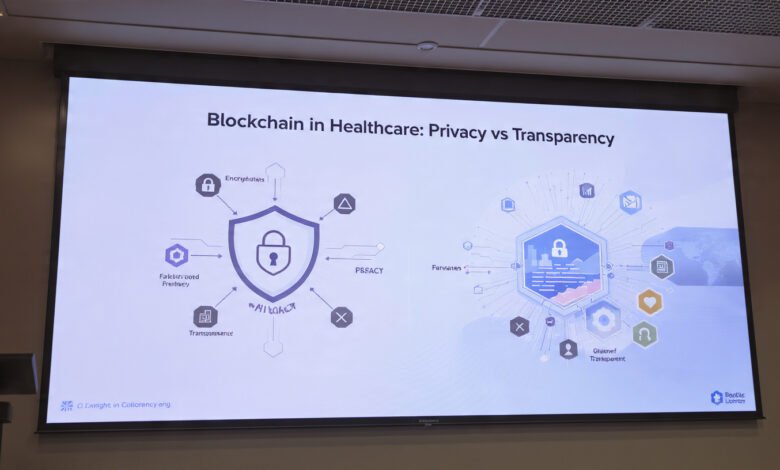
The healthcare industry sits at a crossroads between two competing needs that seem almost impossible to reconcile. On one hand, patients demand absolute privacy over their medical records, test results, and treatment histories. On the other hand, effective healthcare delivery requires seamless information sharing between doctors, hospitals, insurance companies, and researchers. Traditional systems have struggled to strike this balance, leading to data breaches that expose millions of records annually while simultaneously creating information silos that prevent doctors from accessing critical patient history during emergencies.
Enter blockchain in healthcare, a technology that promises to fundamentally reimagine how medical data flows through our healthcare ecosystem. Unlike conventional databases controlled by single entities, blockchain creates distributed ledgers where information exists simultaneously across multiple locations, making unauthorized changes nearly impossible while maintaining transparent audit trails. This dual nature addresses both privacy concerns through cryptographic protection and transparency requirements through immutable record-keeping.
But can blockchain truly deliver on this promise? As healthcare organizations worldwide pilot blockchain implementations for everything from medical records to pharmaceutical supply chains, the technology faces scrutiny from regulators, skepticism from privacy advocates, and practical challenges around scalability and interoperability. Understanding how blockchain technology navigates the tension between privacy and transparency isn’t just an academic exercise. It represents a potential paradigm shift in how we think about healthcare data ownership, patient consent, and the future of medical information exchange.
Understanding Blockchain Technology in the Healthcare Context
Before diving into the privacy versus transparency debate, we need to establish what blockchain in healthcare actually means beyond the buzzword.
What Makes Blockchain Different from Traditional Healthcare Databases
Traditional healthcare databases operate on centralized models. Your hospital stores your records on servers they control. Your insurance company maintains separate records on its systems. When these organizations need to share information, they use secure portals, fax machines, or direct electronic transfers. Each transfer creates another copy of your data in another database you don’t control.
Blockchain technology flips this model. Instead of centralized storage, blockchain creates a distributed ledger where transaction records exist across multiple nodes in a network. In healthcare applications, these transactions might represent access permissions, data updates, or verification events rather than cryptocurrency transfers.
Key characteristics that make blockchain relevant for healthcare:
- Immutability: Once recorded, data cannot be altered without network consensus
- Transparency: All participants can view transaction histories
- Decentralization: No single entity controls the entire system
- Cryptographic security: Advanced encryption protects data integrity
- Smart contracts: Automated agreements execute when predetermined conditions are met
How Blockchain Creates Audit Trails in Medical Systems
The transparency aspect of blockchain manifests primarily through audit trails. Every time someone accesses, modifies, or shares medical data, the blockchain records this action with a timestamp and user identification. Unlike traditional logs that administrators can alter or delete, blockchain audit trails remain permanent and visible to authorized participants.
This creates unprecedented accountability. If a nurse accesses a celebrity patient’s records out of curiosity, that action leaves an indelible mark. If a pharmaceutical company wants to track a medication batch from manufacturer to patient, every hand-off gets recorded. The question becomes: who gets to see these audit trails, and what level of detail do they contain?


The Privacy Imperative in Healthcare Data
Patient privacy isn’t just a preference in healthcare. It’s a fundamental right protected by regulations like HIPAA in the United States, GDPR in Europe, and similar frameworks worldwide. The consequences of privacy violations extend beyond regulatory fines to include damaged patient trust, reluctance to share symptoms honestly, and real-world harm when sensitive information becomes public.
Why Healthcare Data Demands Special Protection
Medical records contain some of our most intimate information. They reveal mental health diagnoses, substance abuse histories, genetic predispositions, reproductive choices, and chronic conditions that could affect employment or insurance eligibility. A single breach can expose information that follows patients for decades.
According to the U.S. Department of Health and Human Services, healthcare data breaches exposed over 133 million records between 2009 and 2024. These breaches resulted from hacking incidents, insider threats, lost devices, and system vulnerabilities in traditional centralized databases.
Blockchain in healthcare addresses several privacy vulnerabilities inherent to centralized systems:
- Single point of failure elimination: Distributed architecture means hackers can’t compromise the entire system by breaching one server
- Encryption by default: Data gets encrypted before being added to the blockchain
- Access control through private keys: Only individuals with the correct cryptographic keys can access specific data
- Patient-controlled permissions: Blockchain enables models where patients grant and revoke access rights
Cryptographic Techniques That Protect Patient Information
The privacy capabilities of blockchain technology rely heavily on advanced cryptography:
Public-private key pairs: Each user receives a public key (like an email address that others can see) and a private key (like a password only they know). Data encrypted with a public key can only be decrypted with the corresponding private key. This ensures that even if someone sees encrypted medical data on the blockchain, they cannot read it without authorization.
Hash functions: Instead of storing actual medical data on the blockchain, systems can store cryptographic hashes—unique digital fingerprints of data. The actual information remains in secure off-chain storage, while the blockchain verifies data integrity. If someone alters a medical record, its hash changes, immediately signaling tampering.
Zero-knowledge proofs: These allow one party to prove they possess certain information without revealing the information itself. In healthcare, this could let a patient prove they received a specific vaccination without disclosing their entire medical history.
Homomorphic encryption: This emerging technique allows computations on encrypted data without decrypting it first. Researchers could analyze population health trends without ever accessing individual patient records.
The Challenge of Perfect Privacy
Here’s where blockchain encounters its first major contradiction. The technology’s transparency—one of its core strengths—conflicts with absolute privacy requirements. A truly transparent blockchain where anyone can view all transactions doesn’t work for healthcare. Even if medical data itself remains encrypted, metadata about who accessed what information when could reveal sensitive patterns.
For example, if blockchain records show a patient accessing fertility clinic records, then nine months later, obstetric records, and then pediatric records, an observer could infer a pregnancy without seeing any actual medical content. This “inference problem” requires careful system design where even access patterns remain protected.
The Transparency Requirement in Healthcare Operations
While privacy protects individuals, transparency serves the broader healthcare ecosystem. Medical systems require visibility for quality assurance, regulatory compliance, research advancement, and fraud prevention.
Where Healthcare Needs Transparent Information Flows
Several healthcare functions fundamentally depend on information transparency:
Clinical coordination: When patients see multiple specialists, each doctor needs visibility into others’ diagnoses and treatments. Duplicate tests waste resources and delay care. Contradictory medications can cause dangerous interactions. Transparent health records enable coordinated treatment.
Public health surveillance: Identifying disease outbreaks requires transparent reporting of symptoms, diagnoses, and lab results. During the COVID-19 pandemic, fragmented data systems hampered public health responses. Blockchain technology could enable real-time disease tracking while maintaining patient anonymity through aggregation.
Medical research: Advancing medicine requires access to large datasets. Researchers need to see patterns across thousands of patients to understand disease progression, treatment effectiveness, and risk factors. Transparent data sharing accelerates discoveries.
Supply chain integrity: The pharmaceutical industry loses billions annually to counterfeit medications. Transparent tracking of drugs from manufacture through distribution to pharmacy prevents fake medicines from entering the supply chain. The FDA’s Drug Supply Chain Security Act mandates increased tracking capabilities that blockchain could support.
Billing and claims processing: Insurance claims require verification that treatments occurred as billed. Transparent treatment records prevent fraudulent billing while speeding legitimate claims processing.
Regulatory compliance: Healthcare organizations must demonstrate compliance with quality standards, safety protocols, and privacy regulations. Transparent audit trails on blockchain provide regulators with immutable evidence of compliance efforts.
How Blockchain Enables Selective Transparency
The innovation of blockchain in healthcare lies in enabling transparency where needed while maintaining privacy where required. This selective transparency operates through several mechanisms:
Permissioned blockchains: Unlike public blockchains, where anyone can participate, healthcare systems typically use permissioned blockchains where only authorized entities can join the network. This immediately limits who can view transaction records.
Tiered access levels: Different participants see different information. A patient might view their complete medical history. Their primary care physician seesthe records they’ve been granted access to. A researcher sees only anonymized aggregate data. Insurance companies see only billing-relevant information. Each group operates with transparency appropriate to their role.
Smart contract enforcement: Automated agreements encoded in blockchain technology can enforce complex access rules. A smart contract might grant a specialist access to cardiac records for 30 days following a referral, then automatically revoke access unless explicitly extended. Another might share drug trial data with researchers only after removing all identifying information.
Data minimization through selective disclosure: Rather than sharing entire medical records, blockchain can facilitate sharing only necessary information. A pharmacist doesn’t need your psychiatric history to fill a prescription—they only need medication lists and allergy information.
Real-World Applications Balancing Privacy and Transparency
Moving from theory to practice, several blockchain implementations in healthcare demonstrate how organizations navigate the privacy-transparency balance.
Electronic Health Records on Blockchain
MedRec, developed by MIT researchers, pioneered blockchain-based electronic health records (EHRs). The system stores medical data in existing databases but uses blockchain to manage authentication, confidentiality, accountability, and data sharing. Patients control a private key that grants and revokes provider access. Every access attempt gets recorded on the blockchain, creating a transparent audit trail visible to the patient.
This design separates privacy (who can access data) from transparency (who accessed data when). Medical information remains encrypted and stored off-chain. The blockchain contains only access logs and permission records. Patients gain unprecedented visibility into who viewed their records while maintaining control over future access.
Estonia’s nationwide health information exchange uses blockchain to secure over one million health records. The system maintains transparency for healthcare providers who need to coordinate care while giving patients visibility into every database query touching their records. The implementation reduced prescription errors by 30% through better information sharing while giving patients confidence in system security.
Pharmaceutical Supply Chain Tracking
MediLedger applies blockchain to pharmaceutical distribution, addressing the transparency demands of drug tracking while protecting competitive business information. The system records every transfer of medication from the manufacturer through distributors to pharmacies on a blockchain visible to all participants.
Privacy protections include encrypting commercial details like pricing and volume while making authentication information transparent. Anyone can verify a medication’s authenticity by scanning its blockchain record, but competitors cannot see pricing agreements. This balances public health transparency (stopping counterfeit drugs) with business privacy (protecting trade secrets).
The implementation helped pharmaceutical companies comply with Drug Supply Chain Security Act requirements while reducing verification costs by 40%. It demonstrates how blockchain technology can satisfy regulatory transparency mandates without exposing sensitive commercial information.
Clinical Trial Data Management
Clinical trials present unique privacy-transparency challenges. Patients participating in trials need privacy protection, but researchers require data transparency to validate findings. Regulatory bodies need transparent trial procedures to ensure ethical conduct. Yet pharmaceutical companies want to protect proprietary information about drugs under development.
Blockchain in healthcare research addresses these competing needs through stratified access. Patient data gets anonymized and encrypted, with blockchain recording data collection events without revealing data content. Researchers can verify trial procedures and data integrity through blockchain audit trails without accessing individual patient information. Regulators gain transparent oversight into trial protocols. Results get published on blockchain, creating immutable records that prevent selective reporting or data manipulation.
Insurance Claims and Medical Billing
Fraudulent insurance claims cost the U.S. healthcare system over $68 billion annually. Traditional claims processing requires sending detailed medical information to insurers, raising privacy concerns. Yet insurers need transparency to verify legitimate claims and identify fraud patterns.
Blockchain pilots in claims processing use smart contracts that automatically verify treatment codes against authorization records. When a doctor performs an authorized procedure, the smart contract confirms authorization and triggers payment without requiring detailed medical notes. The blockchain maintains a transparent record of the authorization, treatment, and payment flow visible to relevant parties but not to external observers.
This approach increases transparency in billing relationships while reducing the medical detail flowing to insurance companies. Patients gain privacy because insurers see less clinical information. Providers gain faster payments through automated verification. Insurers gain fraud prevention through transparent audit trails.
Technical Strategies for Maintaining Privacy on Transparent Blockchains
The apparent contradiction between blockchain transparency and healthcare privacy demands sophisticated technical solutions. Several strategies enable systems to maintain both properties simultaneously.
Off-Chain Storage with On-Chain Verification
The most common approach keeps sensitive medical data completely off the blockchain. Actual health records remain in encrypted databases controlled by healthcare organizations. The blockchain stores only cryptographic hashes of these records, access permissions, and transaction logs.
When a doctor needs to access a patient’s records, they request permission through the blockchain. If authorized (either by patient consent or emergency protocols), they receive a decryption key. The blockchain records this access event without recording what information was accessed. The doctor retrieves actual medical data from off-chain storage.
This architecture provides transparency about who accessed data when, while maintaining privacy about data content. It also avoids blockchain scalability issues since medical images and detailed records don’t consume blockchain space.
Zero-Knowledge Proofs in Healthcare Applications
Zero-knowledge proofs represent cutting-edge cryptography that could revolutionize healthcare privacy. These proofs allow verification of facts without revealing underlying data.
Consider prescription drug monitoring programs that track opioid prescriptions to prevent abuse. With zero-knowledge proofs, a pharmacy could prove to regulators that they verified a prescription against a database without revealing patient identity. A patient could prove to an employer that they passed a drug test without disclosing which test or detailed results.
Implementation complexity currently limits zero-knowledge adoption in blockchain in healthcare, but research projects are making these techniques more practical. As the technology matures, it could enable new forms of selective transparency impossible with conventional systems.
Anonymization and Aggregation Techniques
When healthcare data needs broad transparency—such as for public health research—blockchain technology can facilitate sharing anonymized information. Advanced anonymization goes beyond simply removing names and addresses.
Differential privacy adds statistical noise to datasets, making it impossible to identify individuals while preserving overall patterns. A researcher could query a blockchain-based health database about diabetes prevalence in different age groups without ever accessing individual patient records. The system would add carefully calibrated random variation to results, protecting privacy while maintaining statistical validity.
K-anonymity ensures that any individual is indistinguishable from at least k-1 other individuals in a dataset. If k equals 10, then any attribute combination matches at least ten people, preventing identification. Blockchain can enforce k-anonymity through smart contracts that only release query results meeting anonymity thresholds.
Consent Management on Blockchain
One of blockchain’s most promising healthcare applications involves consent management—giving patients granular control over data sharing while maintaining transparent records of their choices.
Traditional consent forms are binary (yes or no to data sharing) and static. Blockchain enables dynamic, granular consent where patients can:
- Grant temporary access that automatically expires
- Allow access to specific data categories while restricting others
- Set different permissions for different providers
- Revoke permissions at any time
- Receive notifications whenever data is accessed
- Understand exactly how their data is being used
All consent changes get recorded on the blockchain, creating a transparent history visible to patients and auditable by regulators. This transparency about consent itself enables privacy by giving patients knowledge and control.
Regulatory Challenges and Compliance Considerations
Blockchain in healthcare must navigate complex regulatory environments designed for centralized systems. Key regulations create specific privacy-transparency tensions.
HIPAA Compliance and Blockchain Architecture
The Health Insurance Portability and Accountability Act (HIPAA) establishes U.S. healthcare privacy standards. HIPAA requires:
- Patient consent for most data uses
- Minimum necessary data sharing
- Patient access to their records
- Ability to correct errors
- Data breach notifications
- Business associate agreements with third parties handling data
Blockchain implementations must address each requirement:
The “right to be forgotten”: HIPAA allows patients to request record amendments. Blockchain’s immutability conflicts with this right. Solutions include storing only hashes on-chain (so off-chain data can be modified) or using editable blockchains that allow authorized changes while maintaining audit trails of modifications.
Business associate agreements: HIPAA requires formal agreements with entities accessing protected health information. In permissioned blockchains, all network participants might technically access encrypted data. Legal frameworks are still evolving around whether blockchain nodes constitute business associates.
Data minimization: HIPAA’s minimum necessary standard says organizations should share only data needed for specific purposes. Blockchain technology facilitates this through smart contracts that enforce selective data sharing, arguably improving compliance beyond traditional systems.
GDPR Implications for Healthcare Blockchains
Europe’s General Data Protection Regulation (GDPR) creates even stricter requirements:
- Explicit consent for data processing
- Right to erasure (“right to be forgotten”)
- Data portability
- Transparent data processing practices
- Privacy by design
The right to erasure particularly challenges blockchain implementations. GDPR requires organizations to delete personal data upon request. Blockchain immutability seemingly prevents this. Legal scholars debate whether:
- Data stored off-chain with only hashes on-chain satisfies erasure requirements (since the hash becomes meaningless without the underlying data)
- Losing the private key to encrypted on-chain data constitutes erasure (since data becomes permanently inaccessible)
- Blockchain’s inherent characteristics make it unsuitable for GDPR-regulated data
Healthcare organizations deploying blockchain in healthcare within European jurisdictions must carefully design systems to satisfy GDPR requirements while leveraging blockchain benefits. Most implementations use permissioned blockchains with off-chain storage specifically to address regulatory concerns.
Emerging Regulatory Frameworks
Recognizing blockchain’s unique properties, some jurisdictions are developing specific regulations:
- Wyoming created legal frameworks recognizing blockchain records as official business documents
- Arizona passed legislation giving electronic signatures on blockchain legal recognition
- The European Blockchain Partnership is developing regulatory sandboxes for healthcare blockchain pilots
These emerging frameworks attempt to balance blockchain innovation with privacy protection, often distinguishing between public and permissioned blockchains and establishing clearer rules around data controllers and processors in distributed systems.
Limitations and Criticisms of Blockchain Healthcare Solutions

Despite promising applications, blockchain in healthcare faces legitimate criticisms regarding both privacy and transparency capabilities.
The Privacy Paradox of Immutable Records
Blockchain’s immutability—often cited as a security feature—creates privacy risks. Once data reaches a blockchain (even encrypted), it remains there indefinitely. Future cryptographic breakthroughs could render today’s encryption obsolete, potentially exposing historical medical records.
Traditional databases allow organizations to update security measures and re-encrypt data with stronger algorithms. Blockchain’s permanence means data encrypted today must remain secure for decades. This creates long-term privacy risks as quantum computing and other technologies advance.
Metadata Leakage and Privacy Inference
Even when medical data stays encrypted, blockchain transactions reveal metadata—who accessed what when, which patients saw which specialists, how often someone queries their records. Sophisticated attackers can infer sensitive information from access patterns.
If blockchain shows a patient accessing reproductive health records, then several weeks later, pediatric records, observers might infer pregnancy. If someone frequently accesses oncology records, an observer might infer a cancer diagnosis. This “inference attack” vulnerability requires careful system design to hide even the fact that access occurred.
Scalability Challenges Limiting Real-World Adoption
Blockchain technology faces significant scalability limitations in healthcare contexts. Medical records include large files—imaging studies, pathology slides, and genetic sequences. Storing these on-chain is impractical. Even storing hashes and metadata for millions of patients creates performance challenges.
Most blockchain implementations process transactions more slowly than traditional databases. Healthcare operations requiring real-time access—emergency room admissions, surgical support, critical lab results—cannot tolerate blockchain’s transaction verification delays. This limits blockchain in healthcare to use cases where slight delays are acceptable.
The Transparency-Privacy Tradeoff in Public Health
Public health interests sometimes conflict with individual privacy. Disease outbreak tracking requires rapid identification of infection patterns, which demands accessing individual patient data. Blockchain systems designed for strong patient privacy may actually hinder public health responses by making data access too difficult.
During the COVID-19 pandemic, fragmented health systems complicated contact tracing and outbreak monitoring. While blockchain technology could have provided a secure data-sharing infrastructure, the same privacy protections that prevent unauthorized access also slow authorized public health investigations. Finding the right balance remains challenging.
The Decentralization Dilemma
Healthcare requires clear accountability when errors occur or when privacy is violated. Blockchain’s decentralized nature complicates accountability. If a breach occurs, who is responsible? The patient who lost their private key? The healthcare provider who stored data incorrectly? The blockchain node operators? The software developers?
Traditional centralized systems have clear data controllers who bear legal responsibility. Distributed blockchain systems blur these lines, creating legal uncertainties that slow adoption and potentially leave patients without clear recourse when privacy violations occur.
Future Directions: Achieving True Privacy-Transparency Balance
As blockchain in healthcare matures, several technical and governance innovations could better balance privacy and transparency.
Hybrid Blockchain Architectures
Next-generation systems are exploring hybrid approaches combining public and private blockchains. Highly sensitive patient data remains on private, permissioned blockchains accessible only to authorized healthcare providers. Aggregated, anonymized data flows to public blockchains for research transparency and public health monitoring.
These architectures use cryptographic bridges between blockchain layers, allowing selective data flow while maintaining privacy. A patient’s cancer diagnosis stays on a private chain, but anonymized statistics about cancer incidence flow to public chains for research access.
Artificial Intelligence and Privacy-Preserving Data Analysis
Blockchain technology combined with AI could enable privacy-preserving analysis. Federated learning allows AI models to train on distributed data without centralizing information. Healthcare organizations could collaboratively improve diagnostic algorithms by training on their local patient data, with only model updates (not actual data) shared via blockchain.
Homomorphic encryption combined with blockchain could allow researchers to run statistical analyses on encrypted medical data stored across the network, receiving results without ever decrypting individual records. These techniques could unlock medical research value while maintaining unprecedented privacy protection.
Patient-Centric Data Ownership Models
The future of blockchain in healthcare may involve fundamental shifts in data ownership. Rather than hospitals and insurers owning patient data with patients having access rights, blockchain could enable true patient ownership, with healthcare organizations having access rights granted by patients.
Patients would maintain private keys to their medical data, stored in personal health records on blockchain infrastructure. They would grant and revoke provider access as needed. This inversion of the current model would dramatically enhance both privacy (patients control their data) and transparency (patients see exactly how data is used).
Quantum-Resistant Cryptography
As quantum computing threatens current encryption standards, blockchain developers are implementing quantum-resistant algorithms. These next-generation cryptographic techniques will protect the long-term privacy of medical data stored on blockchain, addressing concerns about future decryption capabilities.
Several quantum-resistant signature schemes and encryption algorithms are under development specifically for healthcare blockchain applications. Transitioning to these standards before quantum computers become practical will ensure historical medical data remains protected.
Governance Frameworks for Distributed Healthcare Systems
Technical solutions alone cannot balance privacy and transparency. Healthcare blockchain needs governance frameworks defining:
- Who controls network infrastructure
- How disputes get resolved
- Who can access data in emergencies
- How systems comply with regulations across jurisdictions
- Who bears liability for breaches or errors
Industry consortia, regulatory bodies, and patient advocacy groups are developing governance models that leverage blockchain’s technical capabilities while ensuring accountability and ethical data use. These frameworks will be as important as the underlying technology in determining whether blockchain achieves its healthcare promise.
Conclusion
Blockchain in healthcare represents a genuine paradigm shift in how we think about medical information—not simply as data to be secured, but as a resource that must simultaneously remain private for individual protection and transparent for effective healthcare delivery. The technology’s unique architecture, combining cryptographic privacy protections with immutable transparency, offers tools that traditional databases cannot match. Yet realizing blockchain’s potential requires navigating complex technical challenges around scalability, regulatory frameworks that weren’t designed for distributed systems, and fundamental questions about data ownership and control.
The organizations and projects successfully implementing blockchain technology in medical settings are discovering that the privacy-transparency balance isn’t a compromise where one decreases as the other increases, but rather a design challenge where thoughtful architecture, governance, and patient-centered approaches can enhance both properties. As healthcare systems worldwide pilot blockchain solutions for electronic health records, pharmaceutical tracking, clinical trials, and insurance claims, we’re seeing evidence that this balance is achievable—not perfectly, and not easily, but meaningfully enough to justify continued investment and refinement of this transformative technology.