Augmented Reality vs Virtual Reality What’s the Real Difference
Discover the key differences between augmented reality and virtual reality, their applications, advantages, and which technology suits your needs.

The digital landscape continues to evolve rapidly, and two transformative technologies are reshaping how we interact with the world: augmented reality (AR) and virtual reality (VR). While many people use these terms interchangeably, they represent fundamentally different approaches to blending digital and physical realities. Augmented reality enhances your real-world environment by overlaying digital elements, while virtual reality creates a completely immersive digital environment that replaces physical reality entirely.
The distinction between these immersive technologies is crucial for businesses, developers, and consumers alike. The global AR and VR market is experiencing explosive growth, projected to reach $40.4 billion in 2024 and surge beyond $100 billion by 2026. As these immersive technologies continue to permeate industries from healthcare to retail, knowing which technology serves your specific needs has become essential. This comprehensive guide explores the fundamental differences between AR vs VR, their unique applications, technological requirements, and the advantages each brings to different sectors.
Defining Augmented Reality and Virtual Reality
What is Augmented Reality (AR)?
Augmented reality is a technology that overlays digital content—including images, text, videos, and 3D models—directly onto the real world. Users experience augmented reality through devices like smartphones, tablets, AR glasses, and AR headsets. The defining characteristic of augmented reality is that it enhances your existing environment without completely replacing it. Popular examples of augmented reality applications include Pokémon GO, IKEA Place, and Snapchat filters, which allow users to maintain awareness of their surroundings while interacting with digital overlays.
The augmented reality technology works by using a device’s camera to scan the physical environment and then projects computer-generated images, animations, or information onto the live view. This creates a blended experience where the virtual and physical worlds coexist in real-time. AR applications have become increasingly accessible due to the widespread adoption of smartphones equipped with powerful processing capabilities and advanced camera systems.
What is Virtual Reality (VR)?
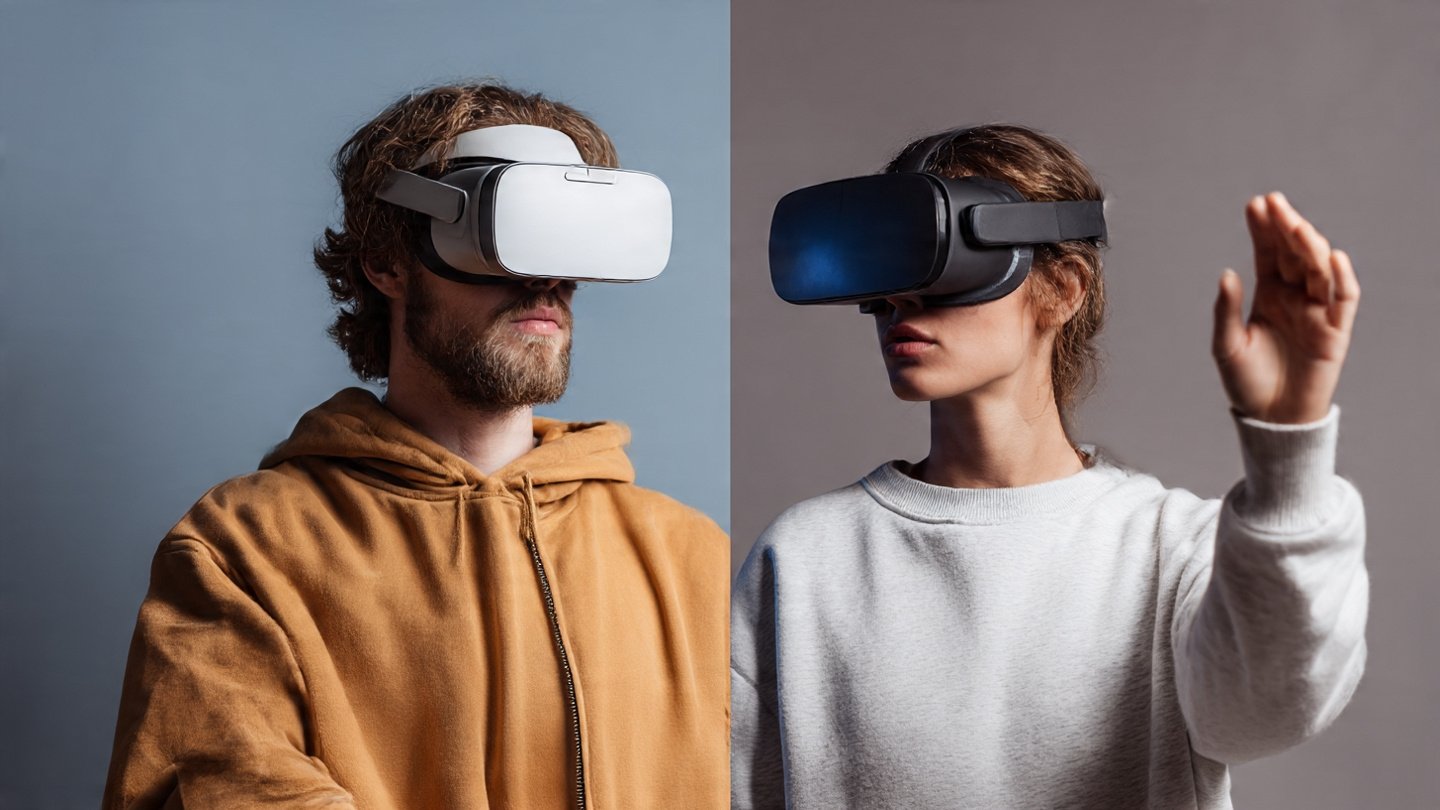
- Virtual reality, conversely, creates a fully immersive digital environment that completely replaces the user’s physical surroundings. Users interact with virtual reality through specialized head-mounted displays (HMDs) such as Meta Quest, HTC Vive, or PlayStation VR, which track their movements and provide 360-degree immersive experiences. Virtual reality aims to transport users into entirely computer-generated worlds where they can explore, interact, and engage with three-dimensional environments as if they were actually present.
- Virtual reality technology uses advanced graphics rendering, spatial audio, and haptic feedback to create realistic and convincing simulations. The immersive nature of virtual reality makes it ideal for applications requiring complete environmental control, such as training simulations, medical procedures, and entertainment experiences. Unlike augmented reality, VR experiences isolate users from the real world, creating an alternate digital reality where anything is possible.
Key Differences Between AR and VR
Level of Immersion
One of the most significant differences between augmented reality and virtual reality lies in their immersion levels. Augmented reality provides partial immersion, allowing users to see both digital and physical elements simultaneously. This blended experience keeps users grounded in their real-world environment while enhancing it with digital information.
Virtual reality, by contrast, offers complete immersion. VR technology creates a fully immersive experience that completely replaces the physical world with a digital one. Users wearing VR headsets see only the virtual environment, becoming isolated from external stimuli. This total immersion makes virtual reality particularly effective for applications where complete environmental replacement is desired, such as flight simulations or exploratory experiences.
Hardware Requirements
The hardware demands differ significantly between these technologies. Augmented reality is more accessible because it typically requires only a smartphone or tablet that most people already own. Some AR applications can even run on basic mobile devices, making augmented reality technology widely available to the general population.
Virtual reality, however, requires specialized hardware. VR headsets are more expensive and computationally demanding than AR devices. High-quality virtual reality experiences often require powerful desktop computers with advanced graphics cards to handle the rendering demands. This hardware requirement has historically limited VR’s accessibility, though prices have gradually decreased as the technology matures.


User Interaction with Environment
- Augmented reality maintains interaction with the physical environment. Users can see and interact with real-world objects while simultaneously engaging with digital overlays. This capability makes augmented reality ideal for applications like navigation, maintenance guidance, and interactive education where real-world context remains important.
- Virtual reality restricts interaction to the virtual environment exclusively. Users cannot see or directly interact with physical objects while wearing VR headsets. Instead, they interact with the virtual environment using specialized controllers, hand-tracking devices, or other input methods. This limitation prevents virtual reality users from simultaneously engaging with real-world elements.
Real-World Context
- Augmented reality maintains constant connection to the real world. The technology enhances your existing surroundings, meaning your physical location, context, and real-time information remain visible and accessible. This contextual awareness makes augmented reality powerful for applications where real-world information is crucial.
- Virtual reality eliminates real-world context. Once immersed in a virtual reality environment, users have no awareness of their physical surroundings, which can be both an advantage (for complete escapism) and a safety consideration (requiring careful monitoring in certain applications).
Technological Architecture and Implementation
AR Technology Stack
Augmented reality applications utilize several core technologies working in concert. Computer vision technology enables devices to recognize and understand real-world environments. Simultaneous localization and mapping (SLAM) technology helps devices understand their position within physical spaces. Rendering engines then overlay digital content appropriately within the scanned environment.
Popular development frameworks for augmented reality include Apple’s ARKit and Google’s ARCore, which provide developers with powerful tools to build sophisticated AR applications. These frameworks have democratized augmented reality development, enabling creators at all skill levels to build engaging augmented reality experiences.
VR Technology Stack
- Virtual reality systems employ different technologies optimized for creating immersive digital environments. High-refresh-rate displays provide smooth visuals that reduce motion sickness. Advanced tracking systems monitor user head position and movement in real-time. Rendering engines generate photorealistic graphics at resolutions and frame rates sufficient for convincing immersion.
- VR development platforms like Unity and Unreal Engine provide comprehensive tools for creating complex virtual reality experiences. These engines support advanced physics simulation, environmental interaction, and multiplayer capabilities necessary for sophisticated virtual reality applications.
Applications Across Industries
AR Applications in Business and Consumer Sectors
Augmented reality applications have revolutionized multiple industries by providing practical, real-world solutions. In retail, brands like IKEA and Sephora use AR technology to let customers virtually try products before purchasing. Customers can visualize furniture placement in their homes or test makeup shades using augmented reality apps, significantly reducing returns and increasing purchase confidence.
In healthcare, augmented reality assists surgeons by overlaying critical patient data and medical imaging directly into their field of vision during procedures. Navigation systems use AR to provide turn-by-turn directions overlaid on actual road views. Maintenance technicians receive AR-guided instructions for complex repairs, with digital diagrams showing exactly where components go. Educational institutions leverage augmented reality to create interactive learning experiences, making complex subjects like anatomy or astronomy more engaging and understandable.
VR Applications in Enterprise and Entertainment
Virtual reality dominates in applications requiring complete environmental control and immersion. In entertainment, VR gaming provides unparalleled interactive experiences where players can explore entire worlds. The aerospace industry uses VR simulations for pilot training, allowing trainees to practice emergency procedures safely before flying actual aircraft.
Medical professionals use virtual reality for surgical training, enabling residents to practice procedures in risk-free environments. Corporate training programs increasingly employ VR simulations for onboarding, compliance training, and skill development. Military organizations utilize virtual reality for strategic simulations and tactical training. Real estate professionals create virtual property tours, allowing potential buyers to explore homes from anywhere globally, revolutionizing the home-buying experience.
Advantages and Disadvantages

Benefits of Augmented Reality
Augmented reality offers exceptional accessibility since most people already possess AR-capable devices (smartphones and tablets). AR technology requires minimal hardware investment compared to virtual reality. The ability to enhance real-world environments while maintaining context makes augmented reality valuable for practical applications. Augmented reality applications don’t cause motion sickness, making them suitable for extended use. Businesses find augmented reality particularly valuable for customer engagement and retention, with studies showing consumers prefer retailers offering AR experiences.
Limitations of Augmented Reality
Augmented reality depends on adequate lighting conditions and clear visual markers for optimal function. Processing limitations on mobile devices can restrict complexity in AR applications. Battery consumption increases significantly when running augmented reality apps. The partial immersion provided by augmented reality makes it less suitable for applications requiring complete environmental replacement or total escapism.
Benefits of Virtual Reality
Virtual reality provides unmatched immersion and presence, making it ideal for applications requiring complete environmental engagement. VR environments offer complete control over all visual and auditory elements. Virtual reality excels at creating safe practice environments for high-risk training scenarios. Users can explore environments and concepts impossible to experience physically. VR technology enables remote collaboration and presence in ways unmatched by other technologies.
Limitations of Virtual Reality
VR headset costs remain substantially higher than AR device costs, limiting accessibility. Some users experience VR motion sickness and associated symptoms like nausea and dizziness. Virtual reality experiences require significant computational power and specialized hardware. Users remain isolated from their physical surroundings during VR sessions, creating safety concerns. The relatively heavy VR headsets can cause user fatigue during extended sessions.
Market Growth and Future Projections
The global augmented reality and virtual reality market continues to accelerate rapidly. Industry analysts project the combined AR and VR market will generate $40.4 billion in revenue during 2024 alone, with expectations of exceeding $100 billion by 2026. The extended reality (XR) market, encompassing AR, VR, and mixed reality technologies, reached $92.5 billion in 2024 and is projected to surge to $1.9 trillion by 2032.
Mobile augmented reality adoption is particularly robust, with over 110 million AR users in the United States alone. Projections indicate 1.19 billion mobile AR users worldwide by 2028. This explosive growth reflects increasing mainstream adoption, declining hardware costs, and expanding practical applications across industries.
The integration of artificial intelligence with AR and VR technologies is driving innovation. Generative AI tools are accelerating immersive content creation, reducing development time and costs. Five-G networks are enabling cloud-based VR and AR solutions, facilitating seamless remote collaboration and high-fidelity content streaming.
Choosing Between AR and VR for Your Needs
Selecting between augmented reality and virtual reality depends entirely on your specific objectives, budget, and target audience.
- Choose augmented reality when you need to enhance real-world environments with contextual digital information. AR technology suits applications where users must maintain awareness of physical surroundings. Augmented reality is optimal when budget constraints require accessible, low-cost solutions. AR applications work best for mobile-first strategies reaching broad audiences. Select augmented reality when integration with real-world locations or objects is essential.
- Choose virtual reality when complete immersion is necessary for optimal experience. VR technology suits training applications requiring realistic, controlled environments. Virtual reality is preferable when you can justify higher hardware costs through specialized use cases. VR applications excel at creating memorable experiences and complete escapism. Select virtual reality when safety-critical training justifies specialized hardware investment.
More Read: What Is Edge Computing and Why Does It Matter
Conclusion
Augmented reality and virtual reality represent two distinct but complementary approaches to merging digital and physical worlds. While augmented reality enhances real-world experiences through digital overlays accessible on smartphones and tablets, virtual reality creates fully immersive digital environments requiring specialized headsets. AR technology prioritizes accessibility and real-world context, while VR technology prioritizes immersion and environmental control.
The choice between augmented reality and virtual reality depends on your specific application, budget constraints, hardware availability, and user experience goals. As both immersive technologies continue advancing rapidly, successful organizations will leverage both AR and VR strategically, deploying each where it delivers maximum value. These fundamental differences empower businesses and developers to harness the appropriate technology for creating engaging, effective, and transformative digital experiences that meet their unique requirements and serve their audiences’ needs.