Quantum Computing Explained Where Are We Actually At
Discover where quantum computing stands in 2025. Learn how quantum computers work, the latest breakthroughs, and real-world applications.

The technological landscape has fundamentally shifted as quantum computing transitions from theoretical research into tangible reality. Quantum computing explained represents one of the most crucial topics in modern technology, as this revolutionary field promises to reshape how humanity solves humanity’s most complex problems. Unlike classical computing, which processes information using traditional binary bits representing either 0 or 1, quantum computers harness the extraordinary principles of quantum mechanics—specifically superposition, entanglement, and quantum interference—to process information in fundamentally revolutionary ways. This paradigm shift unlocks computational capabilities that existing supercomputers cannot achieve, even theoretically.
The current state of quantum computing in 2025 demonstrates remarkable progress that few predicted just five years ago. Google’s Willow quantum processor, unveiled in December 2024, performed calculations in five minutes that would require the world’s fastest supercomputers approximately ten septillion years—far exceeding the age of the universe itself. Simultaneously, Microsoft’s Majorana chip leverages topological qubits representing an entirely new state of matter, while IBM’s quantum systems continue advancing toward practical commercial applications. The United Nations designated 2025 as the International Year of Quantum Science and Technology, commemorating 100 years since quantum mechanics’ initial development—a recognition highlighting the field’s explosive growth and significance.
Yet widespread misconceptions persist regarding where quantum computing actually stands today. Many believe operational quantum computers remain purely theoretical, while others overestimate current capabilities, envisioning near-immediate replacement of classical infrastructure. The reality proves far more nuanced: quantum computers excel at specific problem categories—molecular simulation, optimization, cryptography—rather than general-purpose. This article provides an authoritative, comprehensive examination of quantum computing’s current state, exploring the latest quantum computing breakthroughs, how quantum computers work, confronting the challenges in quantum computing, and examining the real-world applications of quantum technology emerging today. Whether you’re a technology professional, investor, student, or curious observer, the genuine capabilities and limitations of quantum computing technology prove essential for navigating our rapidly evolving technological future.
Quantum Computing Fundamentals
- Quantum computing definition begins with recognizing how fundamentally it differs from classical computer systems. Classical computers process information through binary language—every computation reduces to combinations of zeros and ones. In contrast, quantum computers operate using quantum bits, commonly abbreviated as qubits, which leverage quantum mechanical principles to transcend classical limitations.
- What are qubits? Quantum bits represent the fundamental units of quantum computing technology, existing in states fundamentally different from classical bits. Due to a quantum principle called superposition, individual qubits can exist as 0, 1, or both simultaneously. This remarkable property means a single qubit can represent two computational states at once, while two qubits can represent four states simultaneously, and three qubits can represent eight. This exponential scaling continues, meaning fifty qubits can represent over one quadrillion states concurrently—a computational capacity classical computers cannot match.
- Entanglement, another core quantum computing principle, links qubits together so profoundly that measuring one entangled qubit instantly influences all connected qubits regardless of distance. This interconnection enables quantum computers to process information through sophisticated multi-dimensional algorithms impossible for classical systems. Quantum interference, the third critical principle, amplifies correct computational pathways while canceling incorrect ones, refining results toward accurate solutions.
- Quantum gates, analogous to classical logic gates in classical computing, manipulate quantum bits to perform computations. Unlike classical gates, which produce definitive outputs, quantum gates orchestrate the probability distributions underlying quantum states, enabling the remarkable computational advantages quantum computers provide over traditional computing systems.
The Current State of Quantum Computing: 2025 Breakthroughs
- Where is quantum computing now in 2025? The field has reached an inflection point where quantum computing transitions from laboratory curiosity to a practical tool. Quantum computing breakthroughs 2025 demonstrate unprecedented momentum, though significant challenges remain before achieving full commercial viability.
- Google’s Willow Achievement: Google’s Willow quantum chip represents perhaps the most significant 2024-2025 milestone in quantum computing advancement. With 105 superconducting transmon qubits, Willow quantum processor successfully demonstrated quantum error correction below threshold—meaning errors decrease as additional qubits are added rather than accumulate. This breakthrough addresses quantum computing’s most pressing challenge. Google’s breakthrough in quantum error correction achieved exponential error reduction by increasing code distance, proving surface codes work at scale.
- IBM’s Progress: IBM quantum computing systems achieved remarkable milestones, including developing the Loon processor and the Nighthawk quantum chip, delivering more complex computations than predecessors. IBM quantum-centric supercomputing, partnered with Japan’s RIKEN institute, successfully simulated the iron-sulfide cluster at bacterial nitrogenase enzyme—a molecule too complex for classical approximation. This real-world application of quantum computing demonstrated genuine utility beyond benchmarking.
- Microsoft’s Topological Breakthrough: Microsoft quantum computing made headlines through its Majorana chip, based on seventeen years of topological qubit research. This development creates logical qubits from novel quantum states possessing neither solid, liquid, nor gas properties. Microsoft’s topological approach potentially enables simpler, more effective quantum error correction, dramatically accelerating drug development, battery technology optimization, and artificial intelligence applications.
- Market Growth: Quantum computing companies generated $650-750 million in revenue in 2024, projected to exceed $1 billion in 2025. The quantum computing market is expected to reach $5 billion by 2030, with fault-tolerant quantum systems anticipated to be commercially viable by the early 2030s.
How Quantum Computers Actually Work

- Quantum computer operation requires grasping several interconnected systems and processes working in concert. Quantum computing architecture encompasses hardware, control systems, and algorithms functioning together.
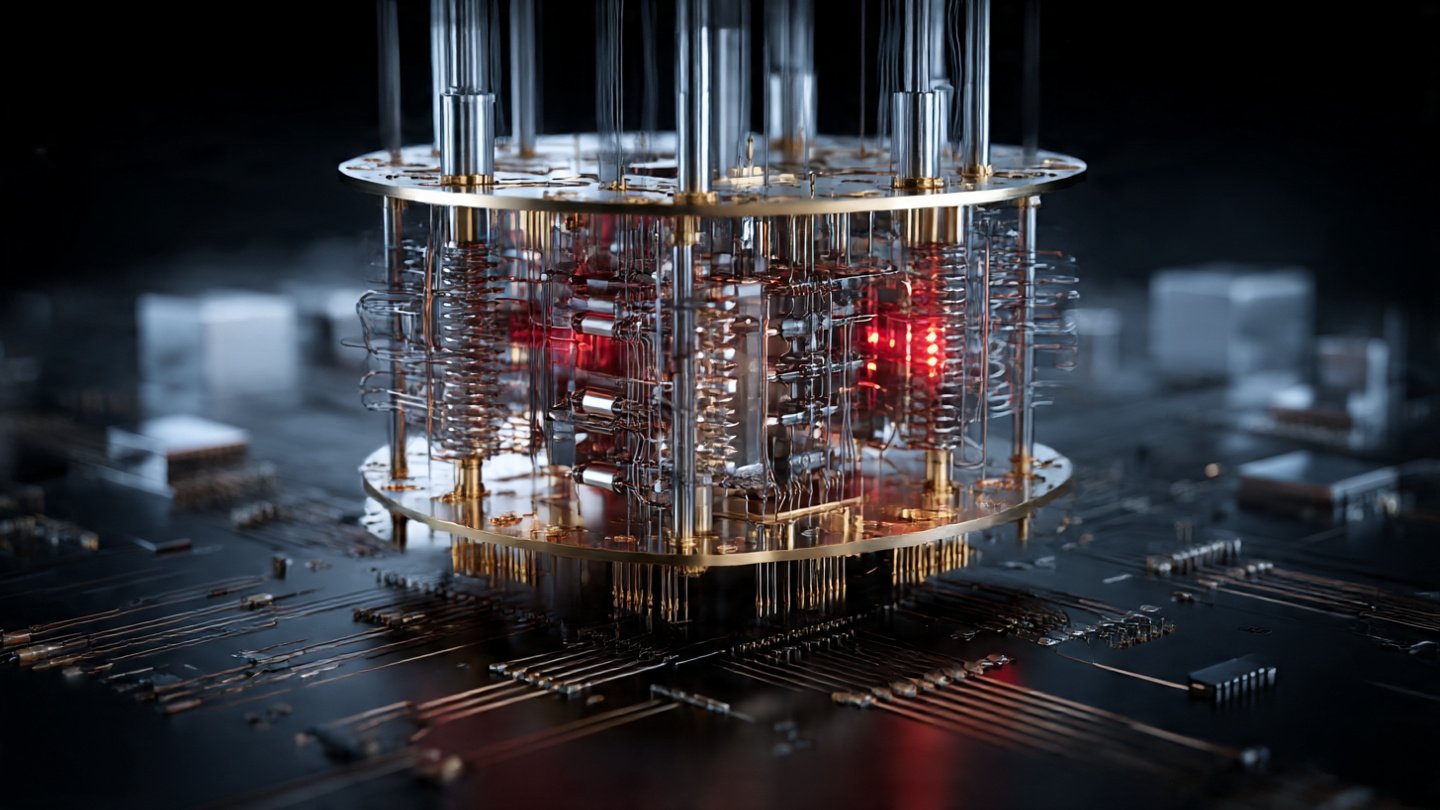
- Physical Qubit Implementation: Quantum computing hardware employs multiple qubit modalities, each with distinct advantages and challenges. Superconducting qubits dominate the current landscape, used by Google, IBM, and others. These superconducting quantum systems utilize circuits of superconducting materials cooled to near absolute zero (typically below 20 millikelvins), where quantum effects dominate classical physics. Microwave photons manipulate these qubits through Josephson junctions, enabling rapid gate operations. Trapped ion qubits, employed by companies like Quantinuum, confine charged atoms with electromagnetic fields, offering longer coherence times than superconducting variants but requiring slower operations. Photonic qubits leverage photons as quantum information carriers, naturally resistant to decoherence but challenging to generate reliably.
- Quantum Processing: How quantum computers solve problems differs fundamentally from classical computation. Rather than checking possibilities sequentially, quantum computers examine multiple pathways simultaneously through superposition. Oracle circuits tag correct answers while quantum interference cancels wrong answers, leaving correct solutions most probable. This quantum computing advantage proves transformative for specific problem categories.
- Control and Measurement Systems: Quantum computing control systems deliver unprecedented precision, managing billions of operations per second while maintaining quantum coherence. Real-time quantum error correction demands control system sophistication exceeding classical requirements. Measurement challenges prove particularly acute—observing quantum states collapses them, destroying superposition unless handled through specialized techniques.
Quantum Error Correction: The Central Challenge
- Quantum error correction (QEC) represents the most critical challenge determining whether quantum computing achieves practical utility. Quantum systems are highly susceptible to noise and decoherence, making effective QEC techniques crucial for realizing scalable and reliable quantum technologies.
- Why Quantum Error Correction Matters: Qubits can behave like zero or one simultaneously and exist in states between zero and one, allowing them to process information much more quickly. However, this same fragility makes qubits extremely error-prone. Quantum error rates currently reach approximately one error per few hundred operations—far exceeding requirements for practical computation. Real-world quantum applications demand error rates reducing to one in a million or better.
- Surface Codes and Logical Qubits: Surface codes, arranging qubits in two-dimensional lattices, represent the most promising quantum error correction approach today. Surface codes are pivotal for scalable quantum error correction in 2025, enabling below-threshold logical qubits with improved fidelity in superconducting systems. By encoding single logical qubits across many physical qubits, this approach detects and corrects errors through entanglement rather than direct measurement. Google’s Willow demonstrated that when physical qubit error rates fall below critical thresholds, logical qubits become more reliable as code distance increases.
- Error Correction Overhead: Implementing quantum error correction requires substantial qubit multiplication. A single logical qubit might demand dozens or hundreds of physical qubits for reliable protection. This overhead dramatically complicates scaling toward practical quantum computers. Achieving fault-tolerant quantum computing—where errors are suppressed sufficiently for arbitrarily long calculations—remains years away despite recent breakthroughs.
- Alternative Approaches: Beyond surface codes, researchers explore color codes, LDPC codes, and bosonic codes. Cat codes and GKP codes show promise in certain quantum communication applications, though scaling remains challenging for general-purpose computation.
Quantum Decoherence: Environmental Enemy Number One
- Quantum decoherence represents perhaps the most fundamental obstacle confronting quantum computer development. Quantum decoherence is one of the most critical challenges in the field of quantum, referring to the process by which a quantum system loses its quantum properties as it interacts with its surrounding environment, effectively turning quantum information into classical information.
- Decoherence: Coherence time, measuring how long qubits maintain quantum states, directly determines the computational duration feasible before errors overwhelm results. Environmental factors, including temperature fluctuations, electromagnetic interference, vibrations, and radiation, cause qubits to lose superposition and entanglement through decoherence mechanisms. Even measurement itself collapses quantum states, destroying the very properties enabling quantum computational advantage.
- Mitigation Strategies: Combating quantum decoherence requires multiple complementary approaches. Cryogenic cooling systems reduce thermal noise by maintaining temperatures near absolute zero. Electromagnetic shielding isolates qubits from stray radiation. Quantum error correction codes protect against decoherence by encoding logical information redundantly. Topological qubits promise inherent decoherence resistance through quantum properties, but remain largely experimental.
- Different Qubit Modalities: Superconducting qubits suffer relatively short coherence times (microseconds) but operate quickly. Trapped ion qubits maintain quantum states for seconds, substantially longer, but require slower operations. Photonic qubits resist decoherence naturally but present other engineering challenges. Topological qubits theoretically offer superior decoherence resistance but remain years from practical implementation.
Real-World Applications of Quantum Computing Today
- Practical quantum computing applications are beginning to emerge despite current hardware limitations. Where quantum computing matters encompasses several high-impact domains.
- Drug Discovery and Molecular Simulation: Quantum computing for pharmaceuticals represents perhaps the most compelling near-term application. Classical computers approximate quantum behavior through simplified models, making accurate molecular simulation impossible. Quantum computers simulating molecular dynamics directly, enabling researchers to understand drug-molecule interactions at atomic precision. IBM’s simulation of the nitrogenase enzyme’s iron-sulfide cluster exemplifies this potential. Quantum-accelerated drug development could collapse multi-year research timelines toward months or weeks.
- Materials Science and Battery Optimization: Quantum computing for materials research enables the discovery of novel compounds with unprecedented properties. Energy storage optimization through quantum computing could accelerate the development of superior batteries, critical for electric vehicles and renewable energy storage. Google has explored quantum computers, designing advanced battery materials with remarkably promising results.
- Financial Modeling and Optimization: Financial institutions explore quantum computing for portfolio optimization, examining vast outcome combinations simultaneously. Risk modeling using quantum computing enables banks to simulate complex market scenarios that months of classical computation would require. The quantum advantage for finance particularly manifests in Monte Carlo simulations, where quantum algorithms demonstrate substantial speedups.
- Cryptography and Security: While quantum computers threaten current encryption, they simultaneously enable quantum cryptography and quantum key distribution. Post-quantum cryptography development addresses threats posed by future quantum-capable adversaries, with NIST standardizing quantum-resistant algorithms by 2035.
- Artificial Intelligence: Quantum machine learning could revolutionize AI training, though practical advantages remain contested. Quantum algorithms for AI potentially accelerate pattern recognition and optimization, enabling AI models currently intractable on classical systems.
- Supply Chain and Logistics: Quantum optimization algorithms excel at tackling traveling salesman problems and supply chain complexities, potentially reducing delivery times and costs substantially across global logistics networks.
Challenges and Obstacles: The Road Ahead
Despite remarkable progress, formidable obstacles remain before quantum computers achieve widespread practical utility.
- Scaling Challenges: Current quantum systems contain dozens to hundreds of qubits. Fault-tolerant quantum computers may require millions of coherent qubits—an engineering feat whose practical feasibility remains uncertain. Manufacturing consistency, maintaining isolated environments, and managing control complexity scale poorly.
- Hardware Limitations: Physical qubit fidelity, the accuracy of quantum operations, directly impacts error rates. Achieving gate fidelities exceeding 99.9% remains difficult. Qubit coherence times must increase substantially, particularly for trapped-ion and superconducting platforms.
- Software and Algorithm Development: Quantum algorithm development demands entirely new thinking. Classical programmers’ intuition fails for quantum computing architecture. Few practitioners understand quantum algorithm design, and no consensus exists on optimal approaches for many problems. Quantum software development requires specialized expertise currently in severe shortage.
- Cost and Accessibility: Quantum computer systems cost tens to hundreds of millions of dollars, accessible only to well-funded corporations, governments, and research institutions. Democratizing quantum computing access through cloud platforms is beginning, but limited availability constrains algorithm development.
- Post-Quantum Cryptography Transition: The cryptographic vulnerability to quantum computers threatens global cybersecurity. Transitioning infrastructure toward quantum-resistant encryption requires coordinated effort spanning governments, enterprises, and technology providers—a massive undertaking stretching across years or decades.
Current Quantum Computing Platforms and Companies
The quantum computing landscape encompasses diverse approaches and multiple significant players.
- Market Leaders: IBM quantum computing maintains substantial influence with IBM Quantum System Two, enabling hybrid quantum-classical. Google Quantum AI leads in error correction research through Willow’s breakthrough. Microsoft Quantum pursues topological approaches. Quantinuum, IonQ, and Rigetti pursue trapped-ion and hybrid strategies. PsiQuantum, receiving $620 million in Australian government funding, targets utility-scale machines. D-Wave, pioneering quantum annealing, commercializes specialized quantum optimization systems.
- Cloud Access: IBM, Google, and Microsoft offer cloud-based quantum computing access, democratizing research participation. Amazon Braket provides quantum computing as a service, aggregating multiple platform access. This cloud quantum computing model enables researchers to explore quantum applications without multi-million-dollar capital investments.
- 2025 Convergence: The competitive quantum landscape converges toward industry standards, with collaboration increasingly complementing competition. The quantum computing race now emphasizes practical utility over qubit counting, fundamentally shifting development priorities.
Quantum Computing vs. Classical Computing: When Does Quantum Win?
When quantum advantage manifests over classical computing proves crucial for realistic expectations.
- Quantum Superiority Domains: Quantum computers excel at specific problem categories: factoring large numbers (cryptographically relevant), searching unsorted databases, simulating quantum systems, optimization across enormous solution spaces, and machine learning on specialized problems. Quantum advantage emerges when problem structure enables superposition and entanglement to amplify correct solutions while canceling incorrect paths.
- Classical Computing Resilience: Classical computers remain superior for everyday tasks—web browsing, document editing, video streaming, and general-purpose. They achieve exabyte data storage and execute quadrillions of operations per second. Classical systems won’t disappear; instead, hybrid quantum-classical computing will emerge, with each solving problems where each excels.
- The True Relationship: Quantum computing augments classical systems rather than replacing them. Future supercomputing architecture likely integrates quantum processors alongside classical systems, with intelligent algorithms routing problems to appropriate platforms.
The Investment Boom and Future Outlook
- Quantum computing investment has accelerated dramatically. Japan announced $7.4 billion in government funding in early 2025, Australia committed $620 million to PsiQuantum, and Illinois pledged $500 million toward quantum infrastructure. Singapore invested approximately $222 million in quantum research.
- Timeline Projections: Industry leaders project fault-tolerant quantum computers arriving between 2027-2035. Commercially viable systems may emerge in the early 2030s. Full-scale quantum computers solving transformative problems likely require 2035-2037 or later.
- Market Potential: Quantum could unlock as much as $250 billion of market value across industries like pharmaceuticals, finance, logistics, and materials science. This enormous potential drives intense competitive positioning.
Quantum Computing in the Broader Technological Context
- Quantum computing’s role in technological evolution deserves perspective. While transformative for specific applications, it complements rather than replaces contemporary technologies.
- AI and Quantum Integration: The quantum-AI convergence generates significant hype but limited clarity regarding actual synergies. Quantum machine learning shows theoretical promise, though practical advantages remain uncertain. Responsible analysis suggests genuine applications will emerge gradually, not imminently.
- Quantum Communication and Sensing: Beyond quantum computing, quantum communication technologies like quantum key distribution offer near-term applications. Quantum sensors demonstrate practical benefits today for precise measurements exceeding classical capabilities.
- Regulatory Landscape: Governments increasingly recognize quantum technology’s strategic importance, implementing policies encouraging domestic development. Quantum talent competition intensifies globally.
More Read: What Is Edge Computing and Why Does It Matter


Conclusion
Quantum computing has definitively transitioned from theoretical research into practical development, with 2025 marking genuine inflection points through Google’s Willow, Microsoft’s Majorana, and IBM’s achievements. Where quantum computing stands today clarifies that this technology promises enormous potential for specific applications—molecular simulation, optimization, cryptography—rather than general-purpose. Quantum computers won’t replace laptops or smartphones, but they will revolutionize how humanity tackles complex problems across pharmaceuticals, finance, materials science, and artificial intelligence.
While formidable challenges persist—particularly quantum error correction, decoherence, and massive scaling requirements—the field’s trajectory suggests commercially viable, utility-scale quantum computers will emerge within a decade. Post-quantum cryptography adoption represents an urgent security priority. Rather than viewing quantum computing as replacing classical systems, progressive organizations are positioning themselves at the intersection of quantum technology, classical, and artificial intelligence—where future competitive advantage will concentrate.
For investors, technologists, and organizational leaders, the moment to develop quantum literacy is now, before practical applications proliferate beyond recovery capacity. The quantum era in computing has unmistakably begun, and the pace of development suggests this decade will prove transformative for understanding and realizing quantum’s extraordinary potential.