Robot Ethics: Should We Be Worried About Automation?
Explore robot ethics and automation concerns: job displacement, AI bias, accountability, privacy, autonomous weapons, and ethical frameworks for responsible automation.

Robot ethics and the question of whether we should be worried about automation have moved from science fiction speculation to urgent policy debates as artificial intelligence, robotic systems, and automated technologies rapidly transform workplaces, economies, healthcare, military operations, transportation, and virtually every aspect of modern life—raising profound ethical questions about job displacement affecting millions of workers, algorithmic bias perpetuating discrimination, accountability when autonomous systems cause harm, privacy erosion through pervasive surveillance, autonomous weapons removing humans from life-or-death decisions, and whether humanity is creating technologies whose consequences we cannot fully predict or control.
The concerns surrounding automation ethics aren’t merely theoretical—real workers already experience job losses to robots and AI, biased algorithms make consequential decisions about loans, hiring, and criminal sentencing, autonomous vehicles have killed pedestrians without clear legal responsibility, facial recognition enables mass surveillance threatening civil liberties, and military forces worldwide develop lethal autonomous weapons that could make targeting decisions without meaningful human control.
Yet focusing exclusively on automation’s risks obscures genuine benefits transforming society—robots perform dangerous jobs, reducing workplace deaths, medical robots enable minimally invasive surgery,s saving lives, automation increases productivity, ty raising living standards, AI assists scientific breakthroughs from drug discovery to climate modeling, and assistive robots help elderly people maintain independence. The question “should we be worried about automation” demands nuanced analysis, sis distinguishing legitimate concerns requiring regulatory responses from technological determinism incorrectly assuming automation inevitably produces specific outcomes regardless of policy choices, social structures, and deliberate decisions about how we develop, deploy, and govern automated systems.
This comprehensive examination of robot ethics and automation explores the major ethical concerns arising from increasing automation including employment impacts, algorithmic fairness, safety and accountability challenges, privacy implications, autonomous weapons, and environmental considerations, analyzes philosophical frameworks for evaluating automation ethics, examines real-world examples where automation raises ethical issues, discusses regulatory and governance approaches, and provides balanced perspective on whether automation worries are justified while offering guidance for developing ethical automation that serves human flourishing rather than undermining it.
Understanding Robot Ethics and Automation
Robot ethics examines the moral principles that should guide the development, deployment, and regulation of robots and automated systems.
Defining Robot Ethics
Robot ethics encompasses multiple overlapping ethical domains addressing different aspects of robotics and automation.
Key ethical dimensions:
Roboethics: Ethics of designing, building, and using robots—what responsibilities do creators and users of robots have?
Machine ethics: Programming ethical behavior into robots and AI systems—can machines make moral decisions?


AI ethics: Broader ethical implications of artificial intelligence,ence including fairness, transparency, accountability, privacy, and human rights.
Automation ethics: Moral considerations around replacing human labor and decision-making with automated systems.
Human-robot interaction ethics: Appropriate boundaries and expectations in relationships between humans and robots, especially social and care robots.
Ethical frameworks applicable to robots:
- Consequentialism: Evaluating automation by its outcomes (does it reduce suffering, increase welfare?)
- Deontology: Certain actare ions intrinsically right or wrong regardless of consequences (is deceiving users always wrong?)
- Virtue ethics: What character traits should guide robot development (prudence, justice, benevolence?)
- Care ethics: Emphasizing relationships, empathy, and vulnerability
Fundamental questions: Do robots have rights or moral status? Who is responsible when robots cause harm? Should certain decisions never be delegated to machines? How do we ensure automation serves human values?
The Scope of Automation
Automation has expanded far beyond factory robots to encompass virtually every sector.
Automation domains:
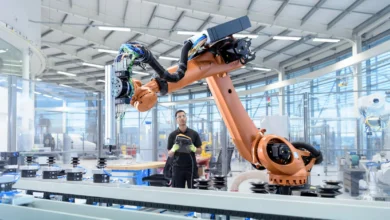
Manufacturing: Industrial robots performing assembly, welding, painting, packaging—traditional automation stronghold.
Transportation: Self-driving vehicles, automated trains, drone delivery, port automation, warehouse robotics.
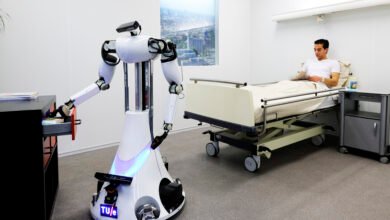
Healthcare: Surgical robots, diagnostic AI, automated drug dispensing, robotic prosthetics, care robots for the elderly.
Finance: Algorithmic trading, automated underwriting, robo-advisors, fraud detection AI.
Retail: Self-checkout, inventory robots, recommendation algorithms, automated customer service.
Agriculture: Autonomous tractors, harvesting robots, precision agriculture systems, livestock monitoring.
Military and security: Drones, autonomous weapons systems, surveillance technologies, border security robots.
Service sector: Food preparation robots, cleaning robots, hotel robots, and delivery robots.
Creative fields: AI-generated art, music composition algorithms, automated journalism, and design tools.
Scope of concern: As automation reaches into more domains—including those requiring judgment, creativity, and social intelligence previously thought uniquely human—ethical questions intensify.
According to analysis from the Brookings Institution, approximately 25% of U.S. jobs are at high risk of automation, with impacts varying dramatically by occupation, education level, and geographic region.
Current State of Automation Technology
Understanding automation capabilities helps assess which ethical concerns are immediate versus longer-term.
Current capabilities:
Narrow AI: Systems performing specific tasks at or above human level (image recognition, speech synthesis, game playing, translation).
Physical automation: Robots performing repetitive tasks in structured environments with high reliability.
Pattern recognition: AI identifying patterns in large datasets that humans cannot process (medical imaging, fraud detection).
Autonomous vehicles: Self-driving technology is operational in limited contexts (highways, mapped areas) but struggles with complex urban environments.
Natural language processing: AI understanding and generating human language with increasing sophistication (though still limited compared to humans).
Limitations:
General intelligence: No AI approaches human-like general intelligence, common sense reasoning, or adaptability to novel situations.
Physical dexterity: Robot manipulation in unstructured environments remains far below human capabilities.
Social intelligence: Robots struggle with nuanced social interactions, empathy, and emotional understanding.
Ethical reasoning: Current AI cannot make genuine moral judgments; fit ollows programmed rules without understanding.
Timeline realism: Despite hype, human-level artificial general intelligence (AGI) remains decades away if achievable at all—current concerns focus on narrow AI and automation, not science fiction superintelligence.
Major Ethical Concerns About Automation
Automation raises multiple serious ethical issues requiring thoughtful responses from technologists, policymakers, and society.
Job Displacement and Economic Inequality
Employment impacts represent the most widely discussed automation ethics concern.
Job displacement risks:
Jobs at high risk: Routine, repetitive tasks—truck drivers, cashiers, telemarketers, data entry, assembly line workers, customer service representatives.
Jobs at medium risk: Some professional roles—legal research, medical diagnostics, financial analysis, journalism- are increasingly assisted or partially automated.
Jobs at lower risk: Roles requiring creativity, social intelligence, physical dexterity in unstructured environments, or complex problem-solving—nurses, teachers, plumbers, managers, artists.
Historical perspective: Technology has always displaced some jobs while creating new ones (farm mechanization eliminated agricultural jobs but created manufacturing jobs; computers eliminated typing pools but created IT jobs).
This time different? Some argue AI/robotics automation fundamentally differs because:
- Replacing cognitive work, not just physical labor
- Happening faster than previous transitions
- May not create enough new jobs or jobs accessible to displaced workers
- Could concentrate wealth in the owners of automation technology
Economic inequality concerns:
Capital vs. labor: Automation may shift economic returns from workers to capital owners, exacerbating wealth inequality.
Winner-takes-all dynamics: AI/robotics industries are characterized by network effects and economies of scale, concentrating wealth in a few dominant companies.
Geographic concentration: Automation benefits and harms are distributed unevenly across regions, creating economic divergence.
Skill polarization: Automation is hollowing out middle-skill jobs while demand grows for high-skill (well-paid) and low-skill (poorly-paid) jobs, shrinking the middle class.
Ethical questions: Do employers have obligations to workers displaced by automation? Should automation benefits be redistributed through taxation? Is a universal basic income ethically necessary if automation eliminates employment for many?
Algorithmic Bias and Discrimination
AI systems can perpetuate or amplify human biases, raising serious fairness and justice concerns.
How algorithmic bias occurs:
Training data bias: AI trained on historical data reflecting past discrimination learns to replicate those patterns.
Feature selection: Choosing which variables AI considers can embed proxy discrimination (zip codes correlating with race).
Feedback loops: Biased AI decisions create biased future data, reinforcing discrimination (predictive policing concentrating in minority neighborhoods).
Lack of diversity: Homogeneous development teams failing to recognize how systems could discriminate against groups they don’t represent.
Optimization for wrong metrics: AI optimizing narrow objectives without considering fairness (maximizing clicks regardless of misinformation spread).
Real-world examples:
Criminal justice: COMPAS recidivism prediction algorithm shown to be biased against Black defendants (ProPublica investigation).
Hiring: Amazon abandoned an AI recruiting tool that discriminated against women by learning from historical hiring patterns.
Healthcare: Algorithms allocating healthcare resources are biased against Black patients by using healthcare spending (which differs by race) as a proxy for health needs.
Lending: Credit scoring algorithms may discriminate based on protected characteristics through proxy variables.
Facial recognition: Higher error rates for dark-skinned individuals and women, leading to false arrests.
Advertising: Job and housing ads are shown selectively by algorithms in ways that may constitute discrimination.
Ethical concerns: Automation can make discrimination harder to detect, more scalable, and harder to challenge—while creating an illusion of objectivity because “the computer decided.”
Accountability and Responsibility
When automated systems cause harm, determining responsibility becomes challenging.
The responsibility gap:
Traditional liability: Straightforward when humans directly cause harm—person responsible for their actions.
Automation challenge:
- Designers: Created the system but didn’t directly cause harm
- Users: Relied on automated decision they may not fully understand
- Manufacturers: Produced a system but didn’t deploy it in a specific context
- The system itself: Made the harmful decision, but isn’t a moral agent
Who’s responsible when:
- Self-driving car killsa pedestrian?
- Medical diagnosis AI misses cancer?
- Does the trading algorithm causes market crash?
- Does the content recommendation algorithm radicalizes viewer?
- Military drone strikes the wrong target?
Legal frameworks lagging: Existing liability law is often unclear on how to assign responsibility for automated decisions.
Moral hazard: If nobody is clearly responsible, incentives for safety decrease.
Transparency and explainability:
Black box problem: Deep learning AI systems make decisions based on patterns in data that even creators cannot fully explain.
Right to explanation: Should people affected by automated decisions understand how the decision was made?
Explainable AI challenges: Trade-off between accuracy and interpretability—most accurate systems often least explainable.
Trust issues: People may not trust automated decisions they cannot understand, even if statistically more accurate than human decisions.
Ethical questions: Can we ethically deploy systems whose decision-making we cannot explain? Who bears liability when automation fails? Should certain high-stakes decisions require human judgment?
Privacy and Surveillance
Automation enables surveillance at scales previously impossible, threatening privacy and civil liberties.
Surveillance technologies:
Facial recognition: Identifying individuals in public spaces, enabling tracking of movements and associations.
Behavioral tracking: AI analyzes online activity, purchases, communications, mand ovements to infer sensitive information.
Emotion recognition: AI claiming to detect emotions from facial expressions (dubious science, privacy invasive).
Biometric identification: Fingerprints, iris scans, gait analysis, and voice recognition, enabling identification.
Data aggregation: Combining data from multiple sources to create detailed profiles.
Predictive analytics: Using data to predict future behavior (creditworthiness, employment performance, health conditions, criminal behavior).
Privacy concerns:
Chilling effects: Surveillance discourages legitimate activities (protest, journalism, seeking health information) due to privacy loss.
Function creep: Systems deployed for one purpose (security) repurposed for others (immigration enforcement, protest monitoring).
Data breaches: Centralized databases of biometric data create honeypots for hackers.
Discriminatory targeting: Surveillance disproportionately focused on marginalized communities.
Authoritarian uses: Democratic societies are developing surveillance infrastructure that could be abused by future authoritarian governments.
Power asymmetry: Corporations and governments know vast amounts about individuals who know little about data collection and use.
Ethical framework: Privacy as a human right essential for autonomy, dignity, and freedom—automation must respect privacy rather than erode it for efficiency or profit.
Autonomous Weapons and Military Applications
Lethal autonomous weapons systems (LAWS) raise unique ethical concerns.
The issue:
Autonomous weapons: Weapons selecting and engage targets without meaningful human control.
Current status: Fully autonomous weapons don’t exist yet, but technology is approaching this capability (loitering munitions, swarming drones).
Ethical concerns:
Accountability: Who’s responsible for wrongful deaths—programmer, commander, manufacturer?
Human dignity: Does delegating life-or-death decisions to machines violate human dignity?
Proportionality and discrimination: Can machines make judgments about proportionality (military advantage vs. civilian harm) and distinguish combatants from civilians in complex environments?
Lowering threshold for conflict: If human soldiers are not risked, will nations more readily use military force?
Arms race dynamics: Autonomous weapons development is creating a destabilizing arms race.
Proliferation: Autonomous weapons technology potentially accessible to non-state actors, terrorists.
Hacking and malfunctions: Autonomous weapons are vulnerable to cyberattacks or errors with catastrophic consequences.
Arguments for LAWS: Could be more precise than humans, reducing civilian casualties; removing humans from direct combat; faster reaction times in defensive scenarios.
International response: Campaign to Stop Killer Robots advocates for a preemptive ban; UN discussions ongoing, but no international treaty yet; some countries developing LAWS while others call for prohibition.
Ethical consensus: Widespread agreement that some meaningful human control should remain overthe use of lethal force, though specifics are debated.
Environmental and Resource Impacts
Automation’s environmental ethics receive less attention but carry significance.
Environmental concerns:
Energy consumption: Data centers powering AI consume massive amounts of electricity (Bitcoin mining is particularly egregious); manufacturing robots are resource-intensive.
E-waste: Rapid technology obsolescence creates electronic waste often disposed of improperly in developing countries.
Resource extraction: Rare earth elements for electronics and batteries have severe environmental and human costs.
Rebound effects: Automation efficiency gains may increase overall consumption (Jevons paradox)—autonomous vehicles making transportation cheaper might increase miles driven.
Potential benefits:
Precision agriculture: Reducing water, pesticide, and fertilizer use through targeted application.
Energy optimization: Smart grids and automated systems reducing energy waste.
Environmental monitoring: Drones and sensors enabling better conservation efforts.
Recycling: Robots are sorting recyclables more efficiently than humans.
Ethical balance: Automation tools can help environmental goals, but require deliberate design choices—not automatic benefit.
Philosophical and Ethical Frameworks

Analyzing automation ethics requires philosophical frameworks for evaluation.
Consequentialist Analysis
Consequentialism evaluates automation by its outcomes.
Utilitarian perspective: Automation is justified if it increases overall welfare (pleasure, preference satisfaction, human flourishing) more than alternatives.
Calculations:
- Productivity gains and lower costs benefit consumers
- Job displacement harms workers
- Health and safety improvements
- Environmental impacts
- Innovation enabling new capabilities
- Inequality effects on social welfare
Challenges: Difficulty predicting consequences, measuring welfare, comparing gains and losses across different people, and accounting for long-term effects.
Conclusion: Automation can increase overall welfare but requires policies ensuring benefits are distributed fairly, and harms are mitigated.
Deontological Considerations
Deontology focuses on duties and rights regardless of consequences.
Key principles:
Human dignity: People deserve respect as autonomous agents, not mere means to ends—does automation treat workers as disposable? Do social robots deceive vulnerable users?
Autonomy: People’s right to self-determination—does automation empower or constrain human choice?
Justice: Fair treatment and distribution—does automation create unjust inequality?
Transparency: Duty to provide information affecting people—should automated decision systems be explainable?
Consent: Respecting people’s choices—are workers and consumers given meaningful consent regarding automation affecting them?
Conclusions: Some uses of automation may be wrong even if the consequences are good (autonomous weapons potentially violating human dignity by delegating life-or-death decisions to machines).
Rights-Based Approaches
The rights framework examines whether automation violates or protects fundamental rights.
Relevant rights:
Right to work: Does automation violate workers’ rights to employment and livelihood?
Privacy rights: Surveillance automation threatens privacy as a human right.
Due process: Automated decisions affecting legal rights may violate procedural fairness.
Non-discrimination: Biased algorithms violate equal protection.
Safety: Right to be protected from harm, including harm from defective automated systems.
Self-determination: Collective right to democratic control over technology shaping society.
Tension: Rights sometimes conflict (privacy vs. security, free expression vs. safety), requiring balancing.
Virtue Ethics
Virtue ethics asks what character traits should guide automation development.
Virtues:
Wisdom/prudence: Careful consideration of automation’s long-term societal effects, not just short-term profit.
Justice: Ensuring automation benefits are distributed fairly, and vulnerable protected.
Temperance: Restraint in deploying automation—not automating everything just because possible.
Courage: Willingness to restrict profitable but harmful automation.
Compassion: Concern for workers displaced and communities affected.
Honesty: Transparency about automation capabilities, limitations, and impacts.
Application: Virtuous developers, corporations, and policymakers would prioritize human flourishing over profit maximization, consider broader social effects, and design automation serving genuine needs rather than creating artificial demands.
Real-World Examples of Automation Ethics
Concrete cases illustrate robot ethics principles and dilemmas.
Self-Driving Cars and the Trolley Problem
Autonomous vehicles raise classic ethical dilemmas in practical contexts.
The trolley problem: If an autonomous vehicle must choose between harming occupants or pedestrians, what should it do?
Moral machine experiment (MIT): Survey revealing cultural differences in ethical preferences—some cultures prioritize passengers, others pedestrians; some value youth over age, others reject such discrimination.
Practical challenges:
Programming ethics: Can’t please everyone; somebody’s ethical preferences will be violated.
Transparency: Should manufacturers disclose how vehicles make such decisions? Might affect purchasing (people may prefer cars that protect occupants).
Regulation: Should governments mandate specific ethical frameworks for autonomous vehicles?
Reality check: Trolley problems are rare compared to broader safety questions (technical reliability, cybersecurity, interaction with human drivers).
Actual accidents: Uber’s self-driving car killed a pedestrian in 2018; Tesla Autopilot was involved in multiple fatalities—highlighting questions of testing, safety standards, and liability.
Ethical lessons: Need comprehensive safety frameworks, clear liability rules, realistic assessment of technology readiness, and democratic deliberation about acceptable trade-offs.
Social Robots and Care
Social robots designed to interact with humans raise unique ethical issues.
Applications: Eldercare, childcare, education, therapy, and companionship.
Ethical concerns:
Deception: Robots designed to elicit emotional responses may deceive vulnerable users (elderly with dementia, children) who attribute more capability and care than robots possess.
Replacement vs. supplement: Should robots supplement human care or replace it? Economic pressures may lead to replacement, even if ethically problematic.
Privacy: Care robots with cameras and sensors create surveillance in intimate settings.
Dignity: Does using robots for eldercare respect elderly dignity or reduce them to problems to be managed?
Attachment: Should we encourage emotional attachment to machines, particularly for children?
Benefits: Robots can provide consistent, patient, non-judgmental interaction; address care labor shortages; offer independence.
Ethical framework: Social robots can supplement human care ethically if users understand robot limitations, human relationships remain primary, privacy is protected, users maintain autonomy, and vulnerable populations are not exploited.
Workplace Automation and Amazon
Amazon warehouses illustrate automation ethics in employment contexts.
Amazon’s automation:
- Kiva robots are moving inventory shelves to workers
- AI optimizing workflow and monitoring productivity
- Increasing automation of picking and packing
Benefits: Increased efficiency, lower costs to consumers, and robots doing physically demanding work.
Concerns:
- Intense productivity pressure monitored by AI systems
- High injury rates among human workers
- Jobs deskilled and depersonalized
- Inadequate breaks as algorithms optimize every minute
- Workers are treated as interchangeable with eventual robot replacements
According to investigative reporting, Amazon warehouse workers experience injury rates significantly above industry average, partly due to productivity pressures from algorithmic management systems.
Ethical questions: What protections should workers have from algorithmic management? Do employers have duties to workers they plan to automate away? Is this efficient use of technology or exploitation?
Predictive Policing
Predictive policing algorithms demonstrate algorithmic bias concerns.
How it works: AI analyzes crime data to predict where crimes are likely to occur, directing police resources accordingly.
Problems:
Feedback loops: Algorithms trained on historical data showing more arrests in minority neighborhoods direct more policing there, generating more arrests confirming the algorithm’s predictions.
Proxy discrimination: Variables like “gang association” or neighborhood disproportionately affect minorities.
Criminalizing poverty: Algorithms may identify poverty indicators as crime predictors.
Lack of transparency: Proprietary algorithms resistant to scrutiny.
Actual impacts: Increased policing in minority communities without evidence of reducing overall crime, while diverting resources from other areas.
Ethical lessons: Historical bias in training data creates biased algorithms; feedback loops amplify discrimination; transparency and accountability are essential; some applications may be inherently problematic regardless of technical improvements.
Governance and Regulatory Approaches
Addressing automation ethics requires governance frameworks balancing innovation with protection.
Current Regulatory Landscape
Regulation of automation remains fragmented and often lags technology.
Existing frameworks:
Product liability: Traditional tort law applies to robots as products, but challenges with autonomy and AI.
Employment law: Labor regulations cover some automation impacts,b ut are not designed for algorithmic management or mass displacement.
Anti-discrimination law: Applies to algorithmic decisions, but enforcementis challenging.
Privacy regulations: GDPR in Europe, CCPA in California, but the US lacks a comprehensive federal privacy law.
Sector-specific rules: Aviation (FAA regulating drones), automotive (NHTSA for autonomous vehicles), medical devices (FDA), and financial services (various regulators).
International initiatives: UN discussions on autonomous weapons; OECD AI Principles; UNESCO AI ethics recommendations.
Gaps: Many automation applications lack specific regulation; enforcement mechanisms are weak; regulations struggle to keep pace with technology; international coordination is limited.
Proposed Solutions
Various proposals aim to address automation ethics concerns.
Employment and economic policies:
Retraining programs: Public investment in education/training for workers displaced by automation.
Portable benefits: Detaching healthcare and retirement from employment as automation increases gig work and job volatility.
Universal basic income: Providing an income floor for all citizens as automation reduces employment opportunities.
Robot taxes: Taxing automation to fund transition programs or redistribute automation benefits.
Reduced working hours: Sharing productivity gains through shorter work weeks.
Strengthened labor rights: Protecting workers from exploitative algorithmic management.
Algorithmic accountability:
Transparency requirements: Mandating disclosure of automated decision systems, particularly in high-stakes contexts.
Impact assessments: Requiring algorithmic impact assessments before deploying in sensitive domains (similar to environmental impact statements).
Testing and auditing: Independent audits of algorithms for bias and other problems.
Right to explanation: Legal right to understand automated decisions affecting you.
Human oversight: Requiring meaningful human involvement in consequential decisions.
Privacy protection:
Strong privacy laws: Comprehensive data protection regulations limiting collection and use.
Surveillance limits: Restrictions on facial recognition and other intrusive technologies.
Data minimization: Requiring only the collection of necessary data.
Purpose limitation: Prohibiting the use of data for purposes beyond the original collection.
Autonomous weapons regulation:
International treaty: Banning or restricting lethal autonomous weapons systems.
Meaningful human control: Requiring human judgment in the use of force.
Transparency: Disclosure of autonomous capabilities in weapons systems.
Ethical AI development:
Ethics boards: Requiring companies to establish ethics review processes.
Diverse teams: Encouraging diversity in AI development to reduce bias.
Ethical training: Education in ethics for engineers and computer scientists.
Public engagement: Democratic deliberation about automation development and deployment.
Conclusion
Robot ethics and whether we should be worried about automation demands nuanced understanding recognizing that legitimate serious concerns exist—including job displacement potentially affecting millions of workers without adequate social safety nets or retraining programs, algorithmic bias perpetuating discrimination through opaque systems making consequential decisions about employment, lending, criminal justice, and healthcare, accountability gaps when autonomous systems cause harm leaving no clear responsible party, privacy erosion through pervasive surveillance enabled by facial recognition and data aggregation, autonomous weapons systems that could remove meaningful human control over use of lethal force, and environmental costs of energy-intensive.
AI systems—while simultaneously acknowledging automation’s genuine benefits, including productivity improvement,s raising living standards, dangerous work performed by robots instead of humans, medical breakthroughs enabled by AI, precision agriculture reducing environmental damage, and assistive technologies helping disabled and elderly individuals maintain independence.
Whether we should be worried about automation ultimately depends on recognizing that automation outcomes aren’t technologically predetermined but result from deliberate choices about how we develop, deploy, and govern these systems, meaning the critical question isn’t whether to allow automation but how to shape it through appropriate regulations addressing algorithmic transparency and accountability, strong privacy protections limiting surveillance, fair labor policies supporting displaced workers, international agreements restricting autonomous weapons, and democratic processes giving citizens voice in automation decisions affecting their lives and communities.
The path forward requires moving beyond simplistic technology optimism assuming automation automatically benefits society or pessimism assuming it inevitably produces dystopia, toward thoughtful engagement with automation ethics that harnesses technology’s potential while implementing safeguards protecting human dignity, rights, and flourishing—recognizing that we should indeed be concerned about automation not because robots themselves are inherently dangerous but because without proper ethical frameworks, regulations, and social policies, automation development driven primarily by profit maximization and military advantage rather than human welfare could exacerbate inequality.
Undermine privacy and autonomy, create new forms of discrimination, and concentrate power in ways threatening democratic governance, making sustained attention to robot ethics not paranoid fear-mongering but responsible stewardship of powerful technologies that will profoundly shape human society for generations to come.