Robots in Warehouses How Amazon and Others Use Them
Discover how warehouse robots revolutionize fulfillment. Explore Amazon's automation technology, warehouse automation benefits, and top robotic.

The warehousing landscape has undergone a dramatic transformation in recent years, with warehouse robots becoming central to modern warehouse automation strategies. What was once the domain of science fiction has become operational reality, as companies ranging from e-commerce giants to pharmaceutical distributors embrace robotic fulfillment systems. Amazon has deployed more than 1 million robots across its operations network since 2012, setting the standard for how warehouse robotics can fundamentally reshape logistics.
These intelligent machines are not merely tools—they represent a paradigm shift in how goods move through distribution centers, how inventory is managed, and how workers collaborate with advanced technology. The integration of automated warehouse systems demonstrates a commitment to speed, accuracy, and worker safety that traditional manual processes simply cannot match. Unlike previous automation attempts that were rigid and limited in scope, modern warehouse robots leverage artificial intelligence, computer vision, and advanced sensors to adapt to changing warehouse conditions in real time.
This article explores the cutting-edge world of warehouse automation technology, examining how industry leaders implement these systems and what benefits they deliver. Understanding the mechanics and advantages of warehouse robotics solutions is essential for businesses considering their own automation journey. The future of warehousing belongs to those who can harness the power of intelligent machines while maintaining meaningful human collaboration on the warehouse floor.
How Warehouse Robots Operate: Technology Behind Automation
Warehouse robots function through a sophisticated combination of hardware, software, and intelligent navigation systems. The core technology enabling warehouse automation relies on several integrated components working in perfect synchronization. Mobile robots utilize sensors, cameras, and LiDAR technology to navigate warehouse floors autonomously, avoiding obstacles and optimizing their routes in real time. Digit is designed to perform tasks in environments built for humans, making it suitable for navigating and operating within traditional warehouse settings, equipped with cameras, sensors, and LiDAR to navigate efficiently, along with two robotic arms that enhance its ability to grasp and move objects.
The warehouse robotics systems that power fulfillment operations typically operate through a centralized warehouse management system that communicates with individual robots. When a customer order is placed, the system analyzes inventory locations and dispatches the nearest robotic fulfillment solution to retrieve items. These automated warehouse robots follow predetermined or dynamically calculated paths, responding to real-time warehouse changes.
The real innovation in warehouse automation technology lies not in the robots themselves, but in the artificial intelligence algorithms that orchestrate their movements. Advanced machine learning models predict demand patterns, optimize picking routes, and ensure efficient inventory consolidation. Cloud-based infrastructure processes data from thousands of robots simultaneously, enabling seamless coordination and continuous performance improvement across entire warehouse automation networks.
Amazon’s Revolutionary Robotic Fleet
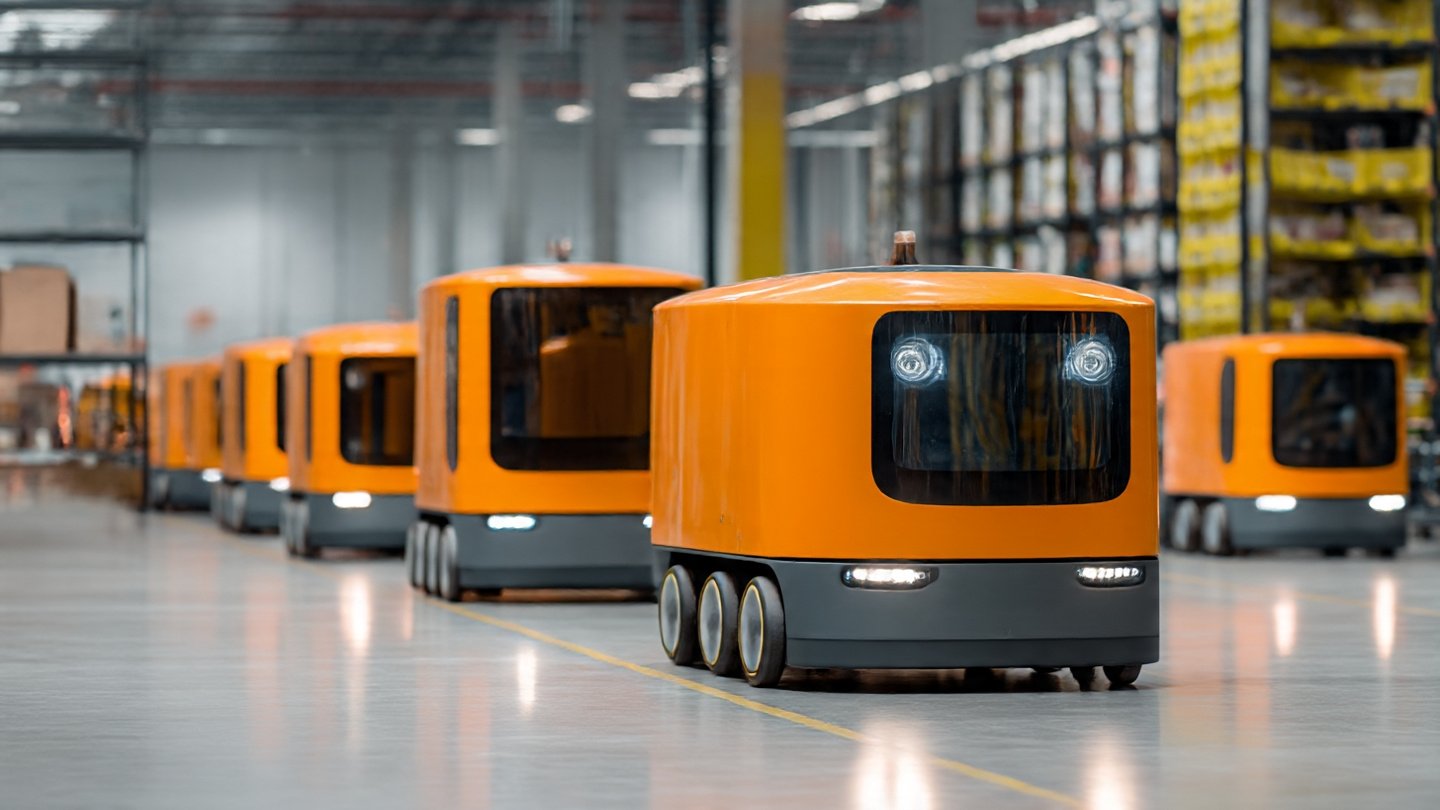
Amazon stands at the forefront of warehouse automation, having pioneered a comprehensive approach to warehouse robotics that few competitors can match. The journey began when Amazon acquired Kiva Systems in 2012 for $775 million, marking a turning point in warehouse automation. Since then, the company has methodically expanded its robotic warehouse capabilities, now operating one of the largest fleets of warehouse robots globally. Systems like Sequoia speed up inventory sortation, while packaging automation creates customer paper bags for orders, showcasing how Amazon’s warehouse automation solutions address multiple operational challenges simultaneously.
Amazon’s current warehouse robotics portfolio includes several specialized systems, each designed for specific tasks within fulfillment operations. The company has invested heavily in warehouse robotics technology that works collaboratively with human employees rather than replacing them entirely. Amazon now has over 750,000 robots working collaboratively with employees, taking on highly repetitive tasks and freeing employees up to better deliver for customers.

The Sequoia system represents a breakthrough in warehouse automation, consolidating multiple operations into one streamlined workflow. Proteus, Amazon’s first truly autonomous mobile robot, navigates Amazon facilities using advanced safety and perception technology, operating freely around employees without being confined to restricted areas. This advancement in warehouse robotics demonstrates Amazon’s commitment to creating safer, more collaborative work environments where humans and machines complement each other’s strengths.
Key Robots Driving Amazon’s Warehouse Automation
Amazon’s diverse fleet of warehouse robots includes several innovative systems transforming warehouse automation practices. Sparrow represents a breakthrough in warehouse robotics, featuring a robotic arm capable of independently picking items from inventory pods with precision and consistency. The Vulcan system introduces tactile feedback capabilities to warehouse automation, allowing the robot to sense when items make contact, understand force requirements, and prevent damage during picking operations. Blue Jay combines what used to be three separate robotic stations into one streamlined workplace that can pick, sort, and consolidate in a single place, exemplifying modern warehouse robotics solutions.
Cardinal handles sorting and consolidation tasks, routing packages through fulfillment centers with remarkable speed and accuracy. These warehouse robots work within an ecosystem powered by sophisticated warehouse automation software that tracks every item, every movement, and every transaction. The newer systems incorporate generative AI models designed to make the entire fleet smarter and more efficient. Project Eluna, an agentic AI platform, helps operators build more efficient and safer workflows. This represents the evolution of warehouse automation technology beyond simple task execution to intelligent decision-making and continuous optimization.
Beyond Amazon: Other Leaders in Warehouse Robotics
While Amazon dominates in scale, other organizations have developed impressive warehouse automation capabilities. Locus Robotics offers collaborative mobile robots designed specifically for high-volume order fulfillment environments. Their LocusONE platform combines hardware, software, and artificial intelligence to create comprehensive warehouse robotics solutions. Locus Origin is a collaborative mobile robot that enhances productivity by over 2x, with an adaptable design supporting multi-level shelving and a variety of container types, making it suitable for tasks like picking, putaway, and replenishment.
Symbotic powers large distribution centers for major retailers, providing automated systems that work alongside human operators. Symbotic powers large DCs for Walmart, Target, and Albertsons, and in January 2025, agreed to acquire Walmart’s Advanced Systems and Robotics business alongside a related commercial agreement. Swisslog, a subsidiary of industrial robot manufacturer KUKA, specializes in warehouse automation solutions for pharmaceutical, cold storage, and retail environments.
Their AutoStore system represents an alternative approach to warehouse robotics, using compact robots and smart shelving for efficient space utilization. Geek+, GreyOrange, and inVia Robotics have each developed specialized warehouse robots addressing specific fulfillment challenges, proving that warehouse automation solutions extend far beyond Amazon’s proprietary systems.
Types of Warehouse Robots and Their Functions
Different warehouse robots serve distinct operational needs within warehouse automation frameworks. Autonomous Mobile Robots (AMRs) represent the most advanced category, capable of independent navigation throughout warehouses without human guidance or physical barriers. These warehouse robots learn warehouse layouts, adapt to changes, and optimize their own routes in real time. Automated Guided Vehicles (AGVs) follow predetermined paths marked by magnetic strips or electronic guides, transporting pallets and containers efficiently throughout warehouse automation environments.
Robotic arms, also called warehouse robotics manipulators, excel at picking, packing, and palletizing tasks. Robotic arms, also referred to as robotic manipulators, pick and place robots or piece-picking robots, are equipped with multiple joints and end-effectors to handle a wide range of tasks, and in logistics, they are used for picking, packing, and palletizing products.
Automated Storage and Retrieval Systems (ASRS) optimize warehouse space by using tall structures with robots that move vertically and horizontally to access inventory. Conveyor-integrated sorting systems automatically categorize and route packages based on destination and order requirements. Collaborative cobots work alongside human employees, enhancing their capabilities rather than performing entirely independent operations. This diversity of warehouse robots ensures that companies can build customized warehouse automation solutions matching their unique operational demands and spatial constraints.
Benefits of Warehouse Automation for Business Operations
Implementing warehouse automation delivers transformative advantages across multiple business dimensions. Productivity improvements represent perhaps the most visible benefit, with warehouse robots operating continuously without fatigue, sick days, or vacation requirements. Warehouse robots can work 24/7 without needing a break, speeding up the order fulfillment process. Companies report dramatic increases in units processed per hour—some achieving three to five times traditional picking rates through optimized warehouse automation systems.
Accuracy improvements directly impact customer satisfaction and return rates. Warehouse robotics eliminates human picking errors caused by fatigue, distraction, or miscommunication. Inventory management becomes more precise as warehouse robots continuously update stock levels in real time through integrated scanning capabilities. The integration of robotics in warehouses significantly enhances inventory management accuracy, with automated systems conducting regular inventory counts and updates, ensuring real-time data accuracy and reducing discrepancies.
Cost reduction emerges as a critical advantage, with warehouse automation reducing labor expenses while improving resource utilization. Warehouses implement higher-density storage layouts enabled by warehouse robots that navigate narrow aisles more efficiently than human operators. Safety improvements transform warehouse environments, with warehouse robotics handling dangerous tasks like working at heights, managing hazardous materials, and lifting excessive weights. Worker satisfaction increases as warehouse robots eliminate repetitive, physically demanding tasks, allowing employees to focus on higher-value activities requiring judgment and creativity.
Warehouse Automation Technology and Artificial Intelligence

Modern warehouse robots derive their effectiveness from advanced artificial intelligence capabilities integrated throughout warehouse automation systems. Machine learning algorithms analyze historical data to predict demand patterns, enabling proactive inventory positioning before orders arrive. Computer vision systems allow warehouse robotics to identify items by visual characteristics, verify order accuracy, and detect misplaced inventory. Natural language processing enables warehouse robots to interpret complex instructions and adapt to dynamic warehouse changes communicated through various channels.
Predictive maintenance powered by artificial intelligence prevents unexpected warehouse automation failures. Sensors embedded in warehouse robots continuously monitor performance metrics, identifying components likely to fail before a catastrophic breakdown occurs. This approach dramatically reduces costly downtime in fulfillment operations. Path optimization algorithms ensure that each warehouse robot takes the most efficient route, considering current congestion, inventory locations, and prioritized orders.
Advanced decision-making systems enable warehouse robots to handle edge cases and unusual situations requiring judgment that earlier automation systems couldn’t provide. The integration of generative AI models promises even greater sophistication, with warehouse automation systems becoming increasingly capable of handling complex, multi-step fulfillment scenarios with minimal human intervention.
Warehouse Automation Challenges and Considerations
Despite tremendous advantages, warehouse automation implementation presents legitimate challenges that organizations must address thoughtfully. Initial capital investment for warehouse robots and supporting infrastructure remains substantial, though costs have decreased significantly in recent years. Integration with legacy warehouse management systems requires careful planning to ensure warehouse robotics operates seamlessly with existing databases and workflows. Some companies discover that extensive retrofitting costs partially offset the advantages of newer warehouse automation technologies.
Workforce transition represents a significant consideration, as warehouse automation changes the nature of work within fulfillment centers. While companies emphasize creating new skilled roles around robot maintenance and optimization, the transition period creates uncertainty for existing employees. Training requirements for maintaining and troubleshooting warehouse robots demand investments in employee development and education.
Some warehouse automation implementations initially reduce hiring needs, affecting business growth potential during expansion phases. Safety concerns persist around warehouse robots operating near human workers, though modern systems incorporate multiple safety systems to prevent accidents. Maintenance demands for sophisticated warehouse robotics require specialized technical expertise that may be unavailable in some regions. Scalability considerations become critical, as certain warehouse automation solutions work excellently at specific scales but lose efficiency advantages when dramatically increased or decreased.
The Future of Warehouse Robotics and Automation
The trajectory of warehouse automation technology points toward increasingly sophisticated human-robot collaboration and autonomous decision-making capabilities. Future warehouse robots will likely incorporate advanced haptic feedback, enabling remote operation and manipulation of delicate items by human operators when necessary. Modular warehouse automation systems will allow businesses to scale their robotic fleet incrementally, avoiding large upfront investments while maintaining flexibility. Soft robotics may revolutionize warehouse robotics by enabling gentler handling of fragile items currently requiring human touch.
Integration of Internet of Things (IoT) technology will create truly connected warehouse automation ecosystems where every device, robot, and system communicates in real time. Edge computing will push artificial intelligence decision-making closer to warehouse robots themselves, reducing latency and enabling faster responses to warehouse conditions.
Augmented reality systems may enhance warehouse automation by overlaying digital information on physical warehouse environments, guiding human workers and warehouse robots simultaneously. Autonomous drones could handle inventory verification and small package delivery within warehouse environments. The convergence of 5G networking, blockchain for supply chain verification, and advanced robotics promises warehouse automation systems of unprecedented capability and reliability.
More Read: Social Robots Building Emotional Connections with Machines
Conclusion
The rise of warehouse robots and advancing warehouse automation technology has fundamentally transformed how organizations manage fulfillment operations, with Amazon deploying more than 1 million robots across its operations network since 2012, establishing the new industry standard for efficiency and innovation. Companies like Locus Robotics, Symbotic, Swisslog, and others have proven that effective warehouse automation extends far beyond Amazon’s proprietary systems, offering diverse warehouse robotics solutions suited to various business models and operational requirements.
The combination of autonomous mobile robots, collaborative cobots, advanced AI systems, and intelligent warehouse management software creates unprecedented opportunities for companies to increase productivity, reduce costs, enhance accuracy, and improve worker safety simultaneously. While challenges around capital investment, workforce transition, and technical complexity remain valid considerations, the strategic advantages of warehouse automation clearly outweigh obstacles for most modern fulfillment operations.
As artificial intelligence, sensing technology, and robotics continue evolving at accelerating rates, the next generation of warehouse robots will enable even more sophisticated, adaptive, and human-centered fulfillment environments. Organizations that embrace warehouse automation today position themselves competitively for tomorrow’s supply chain realities, where speed, precision, and scalability determine market leadership and customer satisfaction.

